Latest News
Why Do Podcasters Need The Association for Downloadable Media?
Jul 23rd, 2007 | By James Lewin | Category: General, Podcasting Services  The New York Times today has some interesting coverage of the recent announcement of the Association for Downloadable Media, an organization that hopes to set standards for audience measurement and advertising for downloadable media.
The article takes a look at some of the reasons that some commercial podcasters see a need for the organization:
Susan Bratton, who helped form the Association for Downloadable Media, said her experience as the chief executive of Personal Life Media, which produces audio podcasts on a range of subjects, helped convince her that more industry cooperation was needed to make podcasting a viable business.
Among other things, Ms. Bratton said that technology companies, marketers and publishers need to agree on standard methods for packaging and delivering advertisements, and tracking the number of times an advertisement is heard. Also, there is no consensus on how best to design an advertisement within a podcast. As a result, marketers, advertising agencies and publishers cannot efficiently implement big campaigns across multiple sites.
While many commercial podcasters are already successfully incorporating advertising, there’s a need for standardization to provide advertisers with a greater comfort level with the new technology.
“There are more iPods and other MP3 devices in more places today than there have ever been,” said Dakota Sullivan, chief marketing officer of BlueLithium, an online advertising network. “It seems this notion of personally programmed media, whether video or audio, is the way of the future, and if podcasts are part of that, it makes a lot of sense for us to be there.”
Is Charlie Rose’s Site PBS 2.0?
Jul 23rd, 2007 | By James Lewin | Category: Digital Video Downloads, Internet TV, Streaming Video, Video 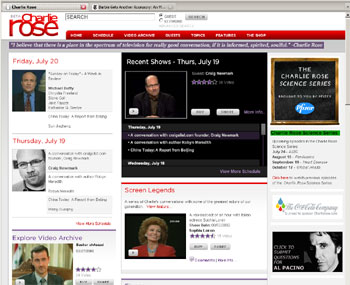
Respected interviewer and journalist Charlier Rose, best known for his Charlie Rose Show on PBS, has introduced a new video portal that’s a great example of a corporate video destination.
The site, now in beta, has great content, is well organized, has news feeds, tagged content, comments, well-implemented search and integrated ecommerce. You can explore the video archive by topic, interviewee, by date, by “most discussed” and through “related videos.”
The site also supports embedding videos. Here’s an example, a recent Rose interview with Craig Newmark of craigslist.com:
If you’re into memes, Charlie Rose’s site represents PBS 2.0.
“The efforts that have gone into this unprecedented venture are truly remarkable. For over a year dozens of individuals have worked in partnership with Google to archive over 4,000 hours of Charlie Rose programming. They’ve broken shows into individual segments, created pictures and collected biographies for guests,” explains Rose. “What we now bring you is a collection of 8,000 segments, over 6,000 guests and 3,600 program hours that currently date back to the 1994-1995 season of the show. This is the single largest enterprise of its kind currently available.”
Read more »
iPhone Hacked Via The Web
Jul 23rd, 2007 | By James Lewin | Category: iPhone, iPods & Portable Media PlayersHackers at SecurityEvaluators.com are claiming that they’ve found a way to compromise the iPhone and created a proof-of-concept exploit capable of delivering files from the user’s iPhone to a remote attacker.
The exploit is delivered via a malicious web page opened in the Safari browser on the iPhone. There are several ways an attacker can get a victim to open such a web page:
- An attacker controlled wireless access point: Because the iPhone learns access points by name (SSID), if a user ever gets near an attacker-controlled access point with the same name (and encryption type) as an access point previously trusted by the user, the iPhone will automatically use the malicious access point. This allows the attacker to add the exploit to any web page browsed by the user by replacing the requested page with a page containing the exploit.
- A misconfigured forum website: If a web forum’s software is not configured to prevent users from including potentially dangerous data in their posts, an attacker could cause the exploit to run in any iPhone browser that viewed the thread. (This would require some slight changes in our proof of concept exploit, however.)
- A link delivered via e-mail or SMS: If an attacker can trick a user into opening a website that the attacker controls, the attacker can easily embed the exploit into the main page of the website.
When the iPhone’s version of Safari opens the malicious web page, arbitrary code embedded in the exploit is run with administrative priviledges.
Read more »
“Feedburner Is Trouble”
Jul 21st, 2007 | By James Lewin | Category: Podcasting ServicesDave Winer, who created RSS 2.0, one of the standards on which podcasting is based, posted an interesting take today on the popular news feed service Feedburner, warning that there’s “danger in giving so much power to one company.”
Feedburner is very popular with podcasters because it can streamline dealing with newsfeeds and offers statistics on podcast “subscribers” and downloads.
“Google owns Feedburner and all their feeds,” notes Winer. “And they could, if they wanted to, change the feeds to another format, overnight, without asking anyone.”
“Technologies work best when there’s lots of competition and lots of choice, and when users are alert and don’t trust companies that don’t deserve their trust,” he ads. “But I can’t say I’ve ever seen that happen for any sustained period, but I still have hope it could happen someday.”
StreetIQ.com Launches App for Business and Financial Podcasts on Facebook
Jul 21st, 2007 | By James Lewin | Category: Audio Podcasting, Making Money with Podcasts, Podcast Directory Sites, Podcast Distribution, Podcasting Services  StreetIQ.com has announced the launch of a Facebook application (registration required) that provides quick access to more than 400 business and financial podcast channels and integrates them into the social networking experience on Facebook.
Using the recently launched software platform at Facebook, StreetIQ.com lets Facebook members access their favorite business and financial podcasts and to share them with their friends and colleagues. StreetIQ.com will also promote its partners and its community of subscribers exclusively through Facebook Groups.
“This is a bold move for StreetIQ.com driven by a firm belief that the viral nature of Facebook will enable us to market our services more effectively,” said Stephen Malaster, founder and director of programming at StreetIQ.com. “In addition, this platform will enhance the user experience for existing users while giving us exposure to new audiences.”
Canada Wants To Tax Your iPod, Give Your Money To The Music Industry
Jul 20th, 2007 | By James Lewin | Category: Audio Podcasting, Citizen Media, Digital Music, Internet TV, iPhone, iPods & Portable Media Players, Podcasting Law, Video Podcasts, VlogsFrom the department of bad ideas that won’t die comes word that Canada may be levying a fee on iPods & other portable media players, along with digital media, to meet demands of an organization that represents the interests of the music and movie industries.
Legal blogger Dr. Micheal Geist has an excellent rundown on the issue:
The Copyright Board of Canada has released its decision on a series of motions contesting the latest attempt by the Canadian Private Copyright Collective to apply the private copying levy to iPods and removable memory storage cards.  The proposed levy was challenged by the Canadian Storage Media Alliance and the Retail Council of Canada, who argued that the Federal Court had already struck down a previous levy on iPods (or more accurately digital audio recorders) as outside the Copyright Act.  The CSMA and RCC argued that the Board had no jurisdiction to consider or approve the levy or alternatively that the CPCC should be prevented from proposing it.
The Board conducted hearings on the motions last month and has responded quickly with an emphatic rejection of the CSMA and RCC.  Siding consistently with the CPCC, the Board has left little doubt that it believes that the earlier decision has not foreclosed the possibility of a levy on devices such as the iPod.  In fact, the Board provides the clearest statement yet that it believes that the levy could be applied to any device, including cellphones and computers.
The levy would effectively make it more expensive for Canadians to use podcasts with portable media devices.
The massive explosion of podcasting, the tremendous popularity of Apple’s iTunes Store and the huge variety of legal free music downloads that are available, demonstrate that there’s a wealth of content that can be legally loaded to portable media players. In addition, there’s a significant trend towards ad-supported Internet media.
Canada needs to bury this idea permanently. Any so-called “iPod-tax” is a subsidy for the status quo, a burden on consumers and a barrier to adoption and innovation for portable media in Canada.
Google Wants To Buy $4.6 Billion Of Wireless Spectrum
Jul 20th, 2007 | By James Lewin | Category: GeneralIf you’ve been wondering about the future of wireless devices like the iPhone in the US, Google just dropped a big hint.
Google announced today that, should the Federal Communications Commission adopt a framework requiring greater competition and consumer choice, the company intends to commit a minimum of $4.6 billion to bidding in the upcoming 700 MHz auction.
In a filing with the FCC on July 9, Google urged the Commission to adopt rules for the auction that ensure that, regardless of who wins the spectrum at auction, consumers’ interests are served. Specifically, Google encouraged the FCC to require the adoption of four types of “open” platforms as part of the license conditions:
- Open applications: Consumers should be able to download and utilize any software applications, content, or services they desire;
- Open devices: Consumers should be able to utilize a handheld communications device with whatever wireless network they prefer;
- Open services: Third parties (resellers) should be able to acquire wireless services from a 700 MHz licensee on a wholesale basis, based on reasonably nondiscriminatory commercial terms; and
- Open networks: Third parties (like internet service providers) should be able to interconnect at any technically feasible point in a 700 MHz licensee’s wireless network.
In other words – Google wants to remake the wireless phone system to be part of the Internet, and they want to own it.
Read more »
Nearly One Out Of Ten Companies Has Fired A Blogger
Jul 20th, 2007 | By James Lewin | Category: Audio Podcasting, Citizen Media, Making Money with Podcasts, Podcasting Law, Podcasting Research, Podcasting Statistics, Video Podcasts, VlogsNearly one out of ten large companies has fired an employee for violating corporate blogging or message board policies, according to a survey conducted by Proofpoint, a company that specializes in corporate messaging security. 19 percent of the companies have disciplined an employee for violating corporate blogging or message board policies.
While we haven’t seen any independent research on this topic & Proofpoint has an interest in demonstrating a need for its content security products….their statistics are still something to keep in mind if you’ve been updating your sex vlog at work.
Proofpoint’s survey was conducted by Forrester Consulting, which polled 308 U.S. companies with more than 1,000 employees.
via Threat Level
PodTech Says Goodbye To Irina Slutsky, Geek Entertainment TV, & A Cool Half Million
Jul 19th, 2007 | By James Lewin | Category: GeneralNewTeeVee reports that PodTech, a tech podcasting startup, has let go Geek Entertainment TV (GETV) host Irina Slutsky, citing a shift in the company’s focus.
PodTech founder John Furrier noted that his company had spent over $500,000 on GETV, and it had failed to meet his goals.
“I had a vision that [GETV] could be a really great franchise,” said PodTech founder John Furrier. “But it just didn’t click.”
PodTech has focused much of its energy on developing video podcasts by geek-tech personalities like Slutsky, Robert Scoble and Jason Calacanis. While PodTech is featuring some respected techies, none has yet demonstrated that they have mainstream appeal.
Sony: The iPod Is A Format
Jul 19th, 2007 | By James Lewin | Category: General 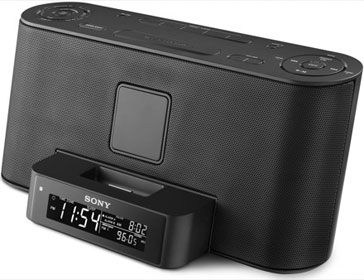
Sony has not only introduced a new clock radio (model ICF-C1iP) and boombox (model ZS-S2iP) with iPod support, but it’s now calling the iPod a format on a par with the compact disc:
“Consumers are treating the iPod as a format, like the compact disc, which is why Sony is now delivering audio products to support it,” said Andrew Sivori, director of personal audio products in the Digital Imaging and Audio Division at Sony Electronics. “High-quality sound, unique features, and exceptional design set our new boombox and clock radio apart.”
Here are the details on their new docks….
Read more »
