Latest News
Samsung Intros 120GB iPod Hard Drive
Apr 25th, 2007 | By James Lewin | Category: GeneralSamsung has introduced a new “jumbo shrimp” hard drive, the 120 GB 1.8-inch SpinPoint N2. The tiny drive¬†brings the first 120GB capacity to portable handheld devices, which could lead to the highest-capacity iPods ever.
Specs:
- The N2 spins at 3,600rpm or 4,200rpm
- 15-ms average seek
- sub-1W power consumption
Production of the 1.8-drive begins in July.
via Engadget
The Future Of Television: Live Video From Your Cell Phone To The World
Apr 25th, 2007 | By James Lewin | Category: Digital Video Recorder, Internet TV, Streaming Video, Video, Video Podcasts, VlogsAt the 2007 National Association of Broadcasters show, ComVu Media demonstrated live video transmitting at 30 fps at 640 x 480 resolution from a mobile phone over a wireless data network. 
ComVu used its PocketCaster software to broadcast full screen video from a Nokia N95 multimedia device, transmitting over HSDPA data connection.¬†Anyone using a Nokia N95 device — including field reporters — can now capture and broadcast video directly to air and concurrently stream live video to Web-portals, blogs and 3G-enabled phones.¬†
ComVu CEO William Mutual called the end-to-end solution “the future of news gathering worldwide.”
Here are¬†the details on how it works…..
Read more »
Steve Jobs Dodges A Bullet; No Charges For Apple In Stock Scandal
Apr 25th, 2007 | By James Lewin | Category: GeneralFederal securities regulators said yesterday that they do not plan to bring civil charges against Apple over its stock-option backdating scandal. Yesterday, former Apple Chief Financial Officer Fred Anderson settled with the Securities and Exchange Commission (SEC), pinning the blame on Jobs for the scandal in the process.
“Steve Jobs dodged a bullet,” said Mark C. Zauderer, a trial lawyer in New York specializing in white-collar cases. “This is another circumstance where the government is going after an easier target. It will generally shy away from situations where the evidence is ambiguous or subject to different interpretations.”
While no plans against Apple are in the works, the SEC would not say whether other individuals could still face action. Unless the government can demonstrate direct involvement by Jobs in the falsification of documents, though, a case against Jobs would likely prove expensive and difficult to win.
Apple Stock-Option Scandal Heats Up
Apr 24th, 2007 | By James Lewin | Category: GeneralIt looks like the Apple stock-option scandal is heating up. Former Apple CFO Fred Anderson has settled with the Securities and Exchange Commission. In doing so, though, he pinned the blame on Apple CEO Steve Jobs.  
“With respect to today‚Äôs announced settlement by the SEC of its complaint against him, Fred is pleased to put this matter behind him,” said Anderson‚Äôs attorney Jerome Roth. “In the settlement Fred makes no admission or denial of the claims by the SEC. The terms of the settlement permit Fred to continue to act as an officer or director of public companies and do not bar him from practicing before the SEC. The claims against him also do not include fraud under the two antifraud provisions of the securities laws requiring proof of knowing misconduct.”
The statement from Anderson’s lawyer effectively shifts the blame for the scandal to Jobs.
Here’s the details from the statement…..
Read more »
AT&T Wants To Sell iPhone As Business Phone
Apr 24th, 2007 | By James Lewin | Category: General  AT&T plans to market the iPhone, an innovative mobile phone that incorporates iPod features and Web capabilities, to business users in addition to consumers, despite the fact that Apple’s mobile phone is expected to be a relatively closed system.
The company has decided that the iPhone will appeal to business users and is now working to ensure that its back-end enterprise billing and support systems will accommodate the device when it ships.
The iPhone is expected to have a number of shortcomings for business users, such as a lack of removable battery. “You’d be crazy to buy without that,” said Ken Dulaney, an analyst with Gartner. The phone also has multiple processors, which consume battery life faster than single processor phones.
The iPhone, an innovative mobile phone that incorporates iPod features and Web capabilities, is expected to become available in June. It will cost $499 or $599 depending on the memory size.
via InfoWorld
Viacom Endorses Fair-Use Rights, Despite Yanking 100,000 YouTube Videos
Apr 24th, 2007 | By James Lewin | Category: General  The Electronic Frontier Foundation (EFF) and Stanford Law School’s Fair Use Project (FUP) today dismissed a lawsuit filed on behalf of MoveOn.org Civic Action and Brave New Films (BNF) against Viacom, citing Viacom’s willingness to take steps to protect the free speech rights of those who post videos to YouTube and similar video sharing sites.
In March, EFF sued Viacom after a parody of The Colbert Report by MoveOn.org Civic Action and Brave New Films was removed from YouTube when Viacom forced YouTube to remove over 100,000 videos. The video parody, Stop the Falsiness, was created by MoveOn and BNF using clips from the Comedy Central television series.
In the course of discussions with EFF and FUP, Viacom described the steps it endorses for protecting fair use and free expression as it targets copyright infringement on Internet video sites. The steps include:
- manual review of every video that is a potential DMCA takedown target,
- training reviewers to avoid issuing takedown requests for fair use, and
- publicly stating that it does not challenge use of Viacom materials that are “creative, newsworthy or transformative” and are “a limited excerpt for non commercial purposes.”
In order to address any similarly erroneous takedown notices in the future, Viacom has agreed to set up a website and email “hotline,” promising a review of any complaint within one business day and a reinstatement if the takedown request was in error.
Read more »
Video Intro To RSS
Apr 24th, 2007 | By James Lewin | Category: GeneralCommoncraft has published a short video introduction to RSS and its benefits:

RSS is a key element in blogging, podcasting and video podcasting.
The Future Of News, With Or Without Anna Nicole Smith
Apr 23rd, 2007 | By James Lewin | Category: Commentary, GeneralBlog and podcast pioneer Dave Winer has an interesting take on the future of news:
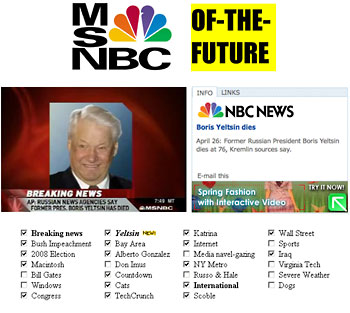
He describes a hypothetical news service where it’s easy to customize the content so that you get the news and information that you’re interested in. By selecting or deselecting checkboxes, you’d determine what news would show up on the page.
 In other words – if you’re sick of headlines about Anna Nicole Smith’s post-mortem troubles, you could de-select the Anna Nicole Smith checkbox, and you wouldn’t see any more of her.
Winer’s idea for a customizable news page isn’t particularly new – just about every Internet news service offers some level of customization and collaborative filtering. But Winer’s right that the future of news needs to be easier to customize, and just plain smarter.
The Future Of News
Winer doesn’t go far enough, though. In this day and age, a progressive news service needs to be:
- Customizable – you should be able to easily add or subtract entire sections, a la Google News
- Personalized – There should be a thumbs-up/thumbs-down option for each story, so that you can give the system feedback on whether or not you’re interested in an article. Give a couple Anna Nicole Smith articles the thumbs-down, and no more stories about who fathered Dannielynn.
- User-driven – Digg has showed that there’s something to be learned from the thousands of other people that use news services. Any modern news service needs to incorporate some form of collaborative filtering to help uncover niche news that may actually have broad interest.
- Respectful of your attention – One of the reasons that Google’s approach to Web advertising has been so successful is that it respects your attention. AdSense takes into account the content of the page it is on and the context of what readers actually click on and uses this information to display the ad that it thinks you’re most likely to be interested in. While this system is far from perfect, it’s blows away most other approaches to advertising. News systems need to be smart enough to show you the content and the ads that you’re likely to be interested in and the ads.
- Source-agnostic – most news systems do a poor job of integrating content from blogs, podcasts and video podcasts. Smart people want to read about the things they are interested, regardless of the news source. Instead of having to use a news site and a blog search and and iTunes to get information from various types of sources, the news service should be intelligent enough to bubble up good content from all sources.
- Multi-platform – an intelligent advertising system needs to be multi-platform and multimedia. People still want to read newspapers – just not newspapers that use yesterday’s technology. News organizations need to harvest information from the activity of users at their websites to create a new form of newspaper that is user-driven, customizable, personalized, source-agnostic and paid for by advertising that serves your needs. The same approach will be applied to television or video news, too.
This is a tremendous opportunity for news organizations that have the resources to combine traditional news gathering with technologies like on-demand printing and video, informed with information gathered from their online presence.
The Internet audience is ready for news our way – with or without Anna Nicole Smith – we’ve got money to spend – and we want it now.
Does Hi-Fi Audio Matter?
Apr 23rd, 2007 | By James Lewin | Category: GeneralApple’s recently announced that they would sell unencrypted audio files from EMI artists in a higher-quality digital audio format – 256 kbps AAC encoding, compared to 128 kbps AAC encoding with DRM. The higher quality will come at a premium, though, as Apple plans to charge about 30% more for the higher quality tracks.
The announcement has some wondering if the extra cost is worth it. Maximum PC recently ran a test, comparing audio saved at different levels of compression.
What they found surprised them:
We all thought it would be a piece of cake, for that matter. With the finest consumer-level soundcard, ace headphones, and tracks we knew by heart, who would have thought that identifying a compressed audio track could be so difficult
With the possible exception of the USB Key that survived a washing and drying cycle, no other Maximum PC Challenge has ever surprised us as much as this one. It’s downright humiliating, in fact, that in many cases, we were unable to tell the difference between an uncompressed track and one encoded at 160Kb/s, the bit rate most of us considered the absolute minimum acceptable for even portable players.
Their results suggest that, while higher bit rate encoding offers improved audio quality, above 160kbps or so most people can’t tell the difference. For people listening to their tracks primarily on ear buds, the quality improvement offered by the higher-quality tracks is likely to be difficult to discern.
Portable Media Player Owners Listening To Less Radio
Apr 23rd, 2007 | By James Lewin | Category: iPods & Portable Media Players, Podcasting Research, Podcasting StatisticsAccording to a new report by broadcasting research firm Arbritron, iPods and portable media players are one of the fastest-growing audio platforms, but the audience for traditional radio remains strong.
While Arbitron’s analysis paints a fairly rosy picture of the state of radio, their stats confirm several industry trends that may cause concern for traditional radio broadcasters:
- More and more people are getting portable media players. The percent of Americans that have portable media players grew from 22% to 30% in the last year.
- Many portable media player owners listen to less radio. Arbitron reports that about a third of those that own iPods or other portable media players listen to less radio as a result.
- Podcasting is one of the few audio platforms seeing significant growth. Awareness of podcasting has lept ahead of HD radio, and its audience is catching up with Internet radio’s audience.
- The audience that traditional media is losing to Internet media tends to be young and affluent.
Read more »
