Latest News
VideoCafé Offers Bloggers Free Video Content & A Taste Of Big Brother
Aug 8th, 2007 | By James Lewin | Category: Internet TV, Streaming Video, VideoThe NewsMarket today launched a new service, VideoCaf√©,¬†that lets bloggers browse and embed free video content from some of the world’s leading organizations.
VideoCaf√© is designed to provide bloggers the same access to video content that television and large media sites have had in the past.¬†Initial footage available for embedding into blogs comes from Google, Yahoo!, Intel, Nintendo, AOL, Dell, Dow Chemical and others. In effect, VideoCaf√© is trying to be a “Web 2.0” style video press release service.
Unfortunately, VideoCaf√© requires bloggers to register and accept a lengthy user agreement in order to browse content and embed video. This¬†will limit acceptance of VideoCaf√©’s offering, because bloggers are used to being able to go to video sharing sites and immediately grab an embed code, without any legal mumbo-jumbo.
We’d also like to see services like VideoCaf√© offer HD tag-based video podcasts of their content, so that video podcasters¬†and vloggers could easily track content to incorporate into their shows.
As it is now,¬†it’s not clear from the VideoCaf√© site why you should sign up for the service. It’s also not clear why companies should pay to use VideoCaf√©, rather than sharing their content at sites like YouTube.
Read more »
The Top Seven Garageband ’08 Improvements For Podcasters
Aug 7th, 2007 | By James Lewin | Category: Audio Podcasting, Podcasting SoftwareApple today introduced an updated version of Garageband as part of the iLife ’08 personal media suite.
Here’s our pick for the top seven new features or improvements for podcasters:
- Multi-take recording – this new feature should make it easier for anyone that has a perfectionist side to get the perfect take without a lot of extra hassle. Garageband ’08 lets select a region for multi-take recording, so you can lay down as many takes as you like. When you’re done, you can play back your multi-take region and switch between versions in real time.
- Save Directly to MP3 – Garageband now lets you save directly to MP3, and supports basic Meta tagging for the files you export.
- More effects – Garageband ’08 doubles the number of effects that you can add to a channel, removing another limitation that has driven users to other apps.
- Automation – Effect automation has been one of the features in Garageband that separates it from professional audio apps. Now you can create an automation curve that turn effects off or on, or fades them in and out. Record an interview that needs some noise reduction, but just in one spot? Now you can automatically bring in the effect when you need. it.
- Arrangements – this is designed to help organize songs into sections like Intro, Verse and Chorus – but the ability to rearrange entire sections of audio as a unit could help streamline podcast show editing.
- Professional EQ – Apple’s added an uber-eq. While not the most glamorous feature, it introduces a new level of audio tweakability to Garageband. A built-in Analyzer displays the frequencies of each track as it plays, which should make it easier to decide which frequencies to cut or boost.
- Voices Jam Pack – this isn’t technically a Garageband feature, but is a very interesting add-on. The Voices Jam Pack is a collection of loops and virtual instruments that let you create a variety of vocal effects, ranging from choirs to human beat-boxing. This will appeal the most to people that are integrating their own music into podcasts, or those of us that need a virtual Bobby McFerrin.
There are some nice improvements in Garageband ’08 that should help out podcasters, especially multi-take recording, automation and better EQ. However, the lack of killer new podcasting features leaves lots of room for third-party developers.
Apple Unveils New iMacs
Aug 7th, 2007 | By James Lewin | Category: Computer Hardware, Podcasting Hardware 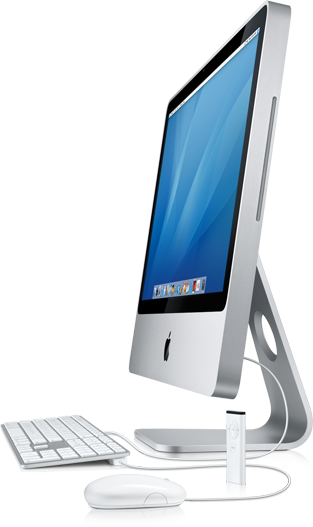
Apple today unveiled a new all-in-one iMac line, featuring 20- and 24-inch widescreen displays encased in aluminum and glass enclosures. The new iMac line features the latest Intel Core 2 Duo processors and a new, ultra-thin aluminum Apple Keyboard, built-in iSight video camera for video conferencing and iLife ’08.
The 20-inch iMac now starts at $1,199, $300 less than the previous 20-inch model, and the 24-inch iMac starts at $1,799, $200 less than the previous 24-inch model.
‚ÄúThis new iMac is the most incredible desktop computer we‚Äôve ever made,‚Äù said Steve Jobs, Apple‚Äôs CEO. ‚ÄúOur new design features the innovative use of materials, including professional-grade aluminum and glass, that are highly recyclable.”
Read more »
Apple Intros iLife ’08
Aug 7th, 2007 | By James Lewin | Category: Audio Podcasting, Podcasting Software, Video PodcastsApple today introduced iLife ‚’08, featuring a major new version of iPhoto and a “completely reinvented” iMovie.
iPhoto 08 automatically organizes photo libraries into Events that let users more easily manage their growing photo collections, and iMovie ‚08 introduces a new way for users to quickly make movies and share them online. Both iPhoto and iMovie integrate with .Mac Web Gallery, Apple‚Äôs service for .Mac members to create and host online websites for their photos and videos.
iLife 08 also features iWeb ‚08, with live web widgets such as Google Maps that let users create even more dynamic websites, and GarageBand ‚08, with a new Magic GarageBand feature that makes it easier to create songs.
“Apple has taken iLife ‚’08 to a new level that is years ahead of anything available for the PC,‚” said Steve Jobs, Apple’s CEO. “We think iLife ‚’08 gives Mac users even more reasons to love their Macs, and PC users even more reasons to switch.‚”
Read more »
Apple Intros New iMacs, Updates iLife
Aug 7th, 2007 | By James Lewin | Category: Computer Hardware, Podcasting Hardware, Podcasting SoftwareApple today introduced new versions of its all-in-one iMac computers and an update to its iLife suite. With the updates, Apple did not offer any big surprises, but instead enhanced its already comprehensive lineup of hardware and software for media publishing.
Updated iMacs
Apple CEO Steve Jobs first showcased the updated iMacs, which now come in 20″ and 24″ versions. The updated iMacs feature aluminum and glass construction, an extremely thin keyboard, and faster processors. The new iMacs are available immediately. A entry-level 20″ iMac will cost $1,199, with a more powerful model available at $1,499. The 24″ iMac will cost $1,799.
iLife ’08
Jobs also introduced a new version of Apple’s suite of home media applications, iLife ’08, calling it “the biggest jump in iLife since we introduced it.” Many of the apps in the suite have podcast capability or podcast-like functions. The apps are tightly integrated with iWeb, so that you can easily publish podcasts, video podcast and Internet photo albums. The new version of iPhoto also has enhanced support for the iPhone.
iMovie has been redesigned to let you browse all your video assets, which is likely to be a resource hog, but should streamline video production. The most popular new feature may be built-in YouTube uploading. This is a great new feature – but we’d like to see Apple offer built-in support for popular blogging platforms.
.Mac
Apple’s online service option for Mac owners, .Mac, has come under criticism because its features were getting creaky. In addition to the tight integration with iLife, Apple’s bumped users’ space up to 10Gb. The updates today should go a long way towards giving .Mac broader appeal.
Other introductions included updated versions of Apple’s iWork productivity package, which has added a spreadsheet, Numbers.
Internet Advertising To Be Largest Ad Market By 2011
Aug 7th, 2007 | By James Lewin | Category: Audio Podcasting, Corporate Podcasts, Making Money with Podcasts, Podcasting Research, Podcasting Statistics Publishers interested in making money with Internet media have advertising trends on their side. According to Veronis Suhler Stevenson (VSS), a private equity firm dedicated to the media, Internet advertising, including pure-play websites and digital extensions of traditional media, will replace newspapers as the largest ad medium in 2011.
 
VSS believes that people are¬†shifting their attention to “alternative” media (including the Internet),¬†and migrating away from advertising-supported media, such as broadcast TV and newspapers, to consumer-supported platforms, such as cable TV and videogames. Time spent with consumer-supported media grew 19.8 percent from 2001 to 2006, while time spent with ad-supported media declined 6.3 percent in the period.
“We are in the midst of a major shift in the media landscape that is being fueled by changes in technology, end-user behaviors and the response by brand marketers and communications companies,” said James Rutherfurd, Executive Vice President and Managing Director at VSS. “We expect these shifts to continue over the next five years, as time and place shifting accelerate while consumers and businesses utilize more digital media alternatives, strengthening the new media pull model at the expense of the traditional media push model.”
 
“Leading national advertisers have accelerated their diversion of dollars from traditional print and broadcast media to alternative digital platforms to combat media and audience fragmentation, increased consumer control and multitasking, and the growing impact of advanced technology on conventional media models. The result has been the extraordinary growth of alternative advertising and marketing,‚Äù Rutherfurd said.¬†
via FT
William Gibson On Internet Media
Aug 7th, 2007 | By James Lewin | Category: GeneralAuthor William Gibson, whose novels have predicted the social implications of Internet technology and the rise of faux-documentary video sensations like LonelyGirl15, offers his vision of how the Internet has wrapped itself around all media, whether its online or offline:
The thing that has affected me most directly during Pattern Recognition, and subsequently, is the really strange new sense I have of the Google-ability of the text. It’s as though there is a sort of invisible hyperlink theoretical text that extends out of the narrative of my novel in every direction.
Someone has a website going where every single thing mentioned in Spook Country has a blog entry and usually an illustration so, every reference, someone has taken it, researched it and written a sort of little Wikipedia entry for it and all in the format of a website that pretends to be from a magazine called Node, which is an imaginary magazine, within Spook Country, and which turns out to be imaginary in the context of the narrative.
I have this sense when I write now that the text doesn’t stop at the end of the page and I suppose I could create web pages somewhere and lead people to them through the text which is an interesting concept. I actually played with doing that in Spook Country but I didn’t know enough about it. Everything is bending towards hypertext now.
Gibson’s vision highlights the way that many of us now get much of our understanding of ideas and events in the physical world from the Internet.
iPhone Gets NES Games, Lousy Gameplay
Aug 7th, 2007 | By James Lewin | Category: iPhone, StrangeA developer, not satisfied with using his iPhone for podcasts, video podcasts, YouTube videos and phone calls, has ported the InfoNES core to the iPhone, along with Mario, Zelda, and other NES roms.
While it demonstrates the¬†computing and gaming capabilities of the iPhone,¬†even the developer¬†admits that the use of virtual controllers for gaming “…while cute, sucks.”
Dell Buys Mobile Media Startup Zing
Aug 7th, 2007 | By James Lewin | Category: Audio Podcasting, Citizen Media, Digital Music, iPods & Portable Media Players  Dell has announced that it has entered into an agreement to buy privately-held ZING Systems, a company that focuses on always-connected audio and entertainment devices. Dell plans to use ZING and its capabilities to continue improving the entertainment experiences it provides its customers.
ZING introduced itself in June of 2006, stating its plans to build “an audio and entertainment engine to drive a new generation of always-connected, mobile digital devices.” Since then, it has announced agreements with Sirius satellite network, FON, SanDisk and others.
While Apple has used a computer-centric model for its mobile media player development, ZING has focused on developing independent wireless functionality.
“Today‚Äôs portable audio devices are tethered to the PC and focused mostly on playback, limited in choice and personalization,” said CEO Tim Bucher. “What people really want to be able to do is enjoy digital content from one device, wherever they are. When you are always connected, the way you listen to music will dramatically change. ZING brings digital content to you and lets you stay tuned.”
Apple’s emphasis on devices that sync with computers has proven beneficial to the growth of podcasting. It’s created a very popular portable media platform that has very low barriers to entry for content providers. ZING’s platform may prove to be a more challenging environment for podcasters, because it emphasizes¬†satellite and streaming radio, which currently have higher barriers to entry.
 
 
Microsoft Wins $1.5 Billion Legal Battle Over MP3 Technology
Aug 7th, 2007 | By James Lewin | Category: Digital MusicMicrosoft has won a reversal of a $1.5 billion jury verdict against it for infringing on a patent for MP3 technology.
Judge Rudi Brewster of the U.S. District Court for the Southern District of California threw out the damages, finding that a jury improperly ruled that Microsoft infringed on one of two pMP3 patents. One of those patents, the judge ruled Friday, was actually co-owned by AT&T, Lucent’s former parent company, and a German company called Fraunhofer, with which Microsoft had a licensing agreement to use the patented technology.
The ruling gives Fraunhofer co-ownership rights to the patent, and the right to license it to Microsoft.
“Today’s ruling by the judge reversing the jury’s $1.52 billion verdict against Microsoft is a victory for consumers of digital music and a triumph for common sense in the patent system,” said Microsoft in a statement.¬†”For the hundreds of companies large and small that rely on MP3 technology, the Court’s ruling clarifies that these companies have properly licensed the technology embodied in the ‘080 patent from its co-owner and industry recognized MP3 licensor–Fraunhofer.”
