Latest News
Windows Mobile Devices Just Got iPwned
Dec 3rd, 2007 | By James Lewin | Category: iPhone, iPods & Portable Media Players, Podcasting Research, Podcasting Statistics 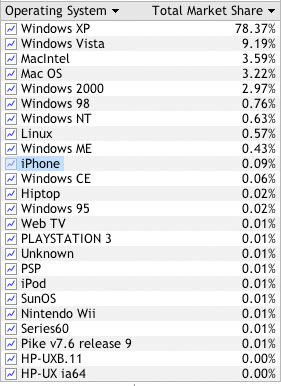
Net Applications has released the latest version of its Internet Operating System Marketshare report, and it reveals some interesting information about the popularity of Apple’s iPhone.
After just five months on the market, the iPhone commands .09% of the marketshare of devices browsing the Internet. The iTouch adds another .01%. Together, Apple’s handheld Internet devices are already about 1 in 1000 machines surfing the Internet.
To put that in perspective, the iPhone has leapfrogged Windows CE, the basis of Windows Mobile devices. Windows CE has been around for 10 years.
While the iPhone hasn’t been around nearly as long other mobile devices, and there aren’t nearly as many iPhones in the field as other Internet devices, the iPhone’s combination of a large screen, a powerful browser and unlimited Internet access has helped it to leapfrog over not just Windows CE devices, but Web TV, the Playstation 3, the PSP and the Nintendo Wii.
Here’s another look at the iPhone’s amazing adoption rate…
Read more »
Natali Del Conte Leaves Podshow For CNET
Dec 3rd, 2007 | By James Lewin | Category: General, Video, Video Podcasts 
Natali Del Conte, host of the technology podcast TeXtra, is reported to be leaving Podshow & TeXtra to host a show for CNET TV.  Del Conte will be moving from San Francisco to New York and joining the CNET TV team.
Del Conte’s has been one of the rising stars of Podshow’s lineup. While some TeXtra fans may have tuned in because of Del Conte’s looks, she brought a strong tech journalism background to the show, having written for WIRED, PC Magazine, MarketWatch and TechCrunch.
Online Advertising To Overtake Radio In 2008 & Magazines By 2010
Dec 3rd, 2007 | By James Lewin | Category: General, Internet TV, Making Money with PodcastsWorldwide internet ad spending will jump to $44.6 billion in 2008, from about $36 billion, increasing its share of the market to 9.4% from 8.1%, according to ZenithOptimedia.
“We predict internet advertising to pass three milestones over the next three years,” according to¬† ZenithOptimedia’s forecast, scheduled for release Dec. 3. “We expect it to overtake radio advertising in 2008; to attain a double-digit share of global advertising in 2009; and to overtake magazine advertising in 2010, with 11.5% of total ad spend.”
Advertising Now International
In addition to noting the growing importance of new media, ZenithOptimedia also notes a trends toward international ad spends.
“North America used to be half of advertising expenditures,” said Tim Jones, CEO of ZenithOptimedia Americas. “We’re seeing its share drop a full point every year at this point. That’s being made up for everywhere east of Eastern Europe. Look at the multinationals and where their investments are focused: the Russias, Chinas and Indias of the world. That’s true of our business and media vendor companies as well.”
Between now and 2010, according to the forecast, the 10 fastest-growing ad markets will be Kazakhstan in the pole position followed by Belarus, Serbia, Egypt, Russia, Moldova, Indonesia, the United Arab Emirates, Ukraine and what the agency refers to as “Pan Arab.”
Top Blogging Site Sold To The Russions
Dec 3rd, 2007 | By James Lewin | Category: General  Six Apart, creators of Movable Type, today announced that SUP, a Russian media conglomerate, has acquired LiveJournal (LJ), a top blogging/social networking site. SUP has launched an American company, LiveJournal, Inc., to manage and operate LiveJournal globally.
This agreement builds on the established and successful relationship between Six Apart and SUP, which entered into a licensing agreement in October 2006 permitting SUP to manage LiveJournal in Russia. The Russian LiveJournal community is second only to the U.S. in number of accounts, and has been influential enough in that country to make “LiveJournal” synonymous with “blogging” in Russian.
“While we’ll miss being LiveJournal’s home, this is a great milestone for LiveJournal and also lets us to focus on the core products invented at Six Apart: Movable Type, TypePad, and Vox,” said Chris Alden, CEO and Chairman of Six Apart. “We are investing heavily in the products and have substantial growth plans for 2008.”
“We have been impressed by the expertise and enthusiasm that SUP has brought to LiveJournal in Russia. They’ve introduced new features, nearly doubled the number of users, invested in key product enhancements, and have done justice to one of the most innovative online social networks in the world. Judging both by SUP’s track record and their eagerness to create a new user advisory board to oversee the community’s interests, this is clearly a good fit,” said Alden.
“Having gotten to know LiveJournal in Russia over the past year, we see enormous potential in developing the business worldwide; it has already shown its durability in America. We believe this is a great opportunity,” said Andrew Paulson, CEO of SUP.
Six Apart acquired LiveJournal in January 2005 from its founder, Brad Fitzpatrick.
Six Apart will continue its active investment in and promotion of the signature open source platform technologies created by the LiveJournal team, such as Memcached, Mogile, Perlbal, and OpenID, all of which have been adopted by other leading web properties from Craigslist to Facebook to Wikipedia.
Association for Downloadable Media Board Members Reveal Goals, Plans
Dec 3rd, 2007 | By Elisabeth Lewin | Category: Audio Podcasting, Corporate Podcasts, Making Money with Podcasts, Video Podcasts  The Association For Downloadable Media (ADM), a newly-formed organization dedicated to “providing standards for advertising and audience measurement for episodic and downloadable media,” announced today the election results for the 20 positions on its board.
Podcasting News Publisher Elisabeth McLaury Lewin talked with some of the newly-elected board members and committee heads, asking about what inspired their involvement in the ADM, as well as their goals for the coming year on the ADM board. Here’s what they had to say:
Risto Koski, Multimedia/ Nokia Music and Podcasting: “In order to get the downloadable media ecosystem to work properly: participation of all industry players is needed: the publishers, aggregators, advertisers and distributing media. This goes naturally beyond North American market from which most ADM members are coming from.
I see the importance of media industry working for standards. Without standards which should based on the true technological capabilities for content and advertising – there will be scattered groups of companies trying to push out proprietary solutions with only limited audience reach for the publishers and advertisers.
Another important issue: without proper measurement standards not only for online (pc/ Mac) – much standardization work is also needed for the ever more focused portable devices. Especially connected, mobile handsets which increasingly offer access to internet media directly through wifi, wimax and 3G/ Edge. I believe these portable devices and mobiles are clearly breaking traditional roles and delivering more control to the user.
My perspective is the next generation of downloadable media: open source and global through the portability and mobility – offering the user the freedom of choice for time and place to create, share and consume content on the go as a part of daily social life.”
Kent Nichols, Ask A Ninja: “The more standardization in the terms of ad units, the less confusion there will be amongst buyers. The less they are confused the more they will buy.
I hope to bring a sense of clarity and cut through the BS that surrounds the industry right now. Form a consensus about which ad formats are working now and what type of measurement is going to be the standard.
And do it from a small publisher’s prospective (I know that seems odd for me to say, but even though AskANinja serves millions of videos a month, we’re still a blip compared to mainstream media).”
Rob Greenlee, (Microsoft) Zune Podcast Programming Lead: “I am hoping to help pull the podcast industry together to develop sponsorship format standards, and help educate existing and future podcasters about all aspects of podcasting. My strongest interest is in industry-wide standards in the implementation of XML-based syndication feeds (RSS & Atom). I also have an interest in marketing and promoting new and unique podcast content to everyday viewers and listeners around the world.”
Jim Louderback, Revision 3 CEO: “We need to legitimize ourselves as an industry and come up with standards around reporting metrics, viewership metrics and ad inventory units. I’m looking forward to working with the board and the rest of the industry to come up with these standards so we can hasten the movement of dollars from traditional TV to online media.
We also need to do a better job helping viewers wade through the monumental amount of dreck out there, and to discover the really great stuff being produced. Discovery is also key, and I’m hoping we can help pioneer some unique ways to solve that problem too.”
Tim Street, creator of French Maid TV: “We need a marketplace for advertisers and online content producers to buy and sell video and audio advertising on the Internet. Without industry standards for downloadable media there will be no marketplace for downloadable media and without an organization like the ADM there will be no industry standards. It was either wait for someone else to do it or get some like minded people involved and do it ourselves.”
C.C. Chapman, The Advance Guard (and the popular music podcast Accident Hash): “I wanted to be part of the Advisory Board to insure that the ADM remembers everyone in the community, and not just big businesses. I hope that the ADM can help out everyone who wants to take their podcast to the next level by monetizing it in some form. I know that isn’t for everyone, but for anyone who wants that, I hope the ADM can help.
As a marketing professional, I’m also hoping that we can bring podcasting to a new level of acceptance as a viable medium for advertisers and brands to use in their campaigns. Right now it is not much more then a buzzword to most of them and I want to help change that!”
Rob Walch, Wizzard Media executive and Podcast411 creator, was elected Chairman of the Education and Outreach Committee: “I have felt an organization like the ADM has been needed in podcasting for quite some time now. When the ADM was announced and I saw the companies involved, and their goals, I felt it was a good thing for podcasting.
Being involved from my perspective is a way for me to pass on to listen[ers] to my show on what is happening in the ADM, and also to get feedback from my listeners to pass back to the ADM. Whether or not a podcaster is a member I am very interested to hear their thoughts and opinions and share them with those in the ADM.
My plans and goals for the ADM are to help get the word out about the great content that is available as a podcast. I also want to help recruit advertising agencies to become part of the ADM.
Essentially it’s a two prong approach – educate potential subscribers and potential advertisers about our medium. To do that, I hope to recruit into the Education and Outreach committee those that are most passionate and informed about our medium.
I welcome anyone who is part of the ADM to contact me if they want to be part of this committee. And for those not yet part of the ADM, please consider joining and actively participating.”
Exclusive Interview With Downloadable Media Chairman Chris MacDonald
Dec 3rd, 2007 | By Elisabeth Lewin | Category: Making Money with Podcasts  Nascent new media industry group, the Association for Downloadable Media, has announced the new officers, committee chairmen, and Advisory Board members. Podcasting News Publisher Elisabeth McLaury Lewin talked with some of the newly-elected board members this weekend.
Here’s what Chris MacDonald, (Executive VP, Business Development and Operations, Libsyn PRO), Chairman (looking chairmanly in this updated photo, right) had to say about his plans and goals for the ADM, and what moved him to become involved in the new organization:
“[Over the last several years], I wanted to start up a conversation with other podcasters and new media creators, stemming from talks with folks at different PodCamps and industry gatherings. I saw a real unmet need for having replicable standards and metrics ‚Äì not in terms of this one particular company or this one existing sort of metric being incorrect ‚Äì more like, how do we craft the language and the matrix and the variety of different ways that value can be applied from a monetization strategy? We came to the conclusion that a lot of it was gonna happen on an ad-supported basis, and that would be a conversation worth having as a group.
“I heard from Susan Bratton [ADM Vice-Chairwoman] around that same time, and she was interested in getting a little more formal, like a trade association, and wondered would I like to be involved. I jumped at the opportunity to do this ‚Äì because it seemed to be the sort of environment that would kick-start this metrics and monetization conversation, and translate it into something concrete. It takes money, coordination, research, many people, a structure, to get these conversations going, and this seemed like a great way to mobilize all these things.
“[The ADM] We have members and officers from all corners of the industry — large broadcasters, independent publishers, large publishers, small and medium-sized companies, nonprofit and for profit ventures, individuals and corporations… a variety of different stakeholders who are attracted to the concept of getting together and sharing information, and bridging the gap that we all know exists between getting advertisers more excited, and growing the industry for all the stakeholders.
“The industry is growing up and we‚Äôre at this place right now where it’s making an undulation. There‚Äôs definitely money to be made, but how? We‚Äôre becoming legitimate in the eyes of older media and advertising. And there have been some interesting strategic directions for communication that help to create a lot of value for advertisers. But, for those of us who are the “experts,” the people who’ve been doing downloadable media for several years now, what do we do with all this sweat equity knowledge we have? And how do we start to communicate as a community?
What’s Next For The ADM
“I think the thing we have to do first [now that the ADM elections are decided], is some of the organizational stuff, to help us get up and rolling. Subject-matter work at the committee level… We now have committee heads, so the work of the committees can get started in earnest.
“What I‚Äôd like to see happen in the coming year at ADM: We have a good base of corporate and non-profit and individual members. And I expect that we will spend a lot of time, getting that membership base even broader and stronger, so our potential resources will increase. Frankly, when you‚Äôre concerned with what we‚Äôre going to be doing, things like primary research, being the focal point for press inquiries about issues of donloadable media, pulling together our diverse collective interests and supporting those, we‚Äôll have to figure out financing and prioritizing our collective goals.
“We also have to talk with advertisers and figure out what they really want and need, before we begin to build a structure for collecting information and doing research about the reach of providers of downloadable media.
“The ADM is a unique organization, in the sense that we‚Äôre not “vertical”, not a trade association per se, but rather we’re a group for solving complex problems. The needs of independent publishers might be different from an advertising-repping company or a measurement company. One of our first things will be to come up with some ways we can work collectively.
“You can expect some very hard work from from the ADM board in the months to come, and people are gonna be hearing from us soon. If someone‚Äôs been sitting on the fence, wondering whether to get involved in the ADM, I really encourage them to come to downloadable media.org. Look around the site, and see what we‚Äôre about. I invite you to become members, and get involved, and join the conversation. Pick out and work on a committee with the subject matter that appeals to you.”
Association For Downloadable Media Officers Announced
Dec 3rd, 2007 | By Elisabeth Lewin | Category: Making Money with Podcasts The Association for Downloadable Media (ADM) announced today the election results for its Executive Board (Chair, Vice Chair, Secretary, Treasurer), Advisory Board seats, and committee chairs.
The ADM, a newly-formed industry organization dedicated to standardization and monetization of new media, has been formed to focus specifically on any content downloaded by consumers, and will work in collaboration with content creators, advertisers, media networks, and related industry associations.
Elected individuals for the 4 Executive positions (Chairman, Vice Chairman, Secretary and Treasurer), 11 Advisory Board seats and 5 Committee Chair positions are:
- Chairman, Chris MacDonald, EVP Business Development and Operations Libsyn PRO Enterprise Platform and Founder of Indiefeed;
- Vice Chairman, Susan Bratton, CEO, Personal Life Media;
- Secretary, Matthew Snodgrass, VP Digital Marketing, Porter Novelli;
- Treasurer, Duncan Perry, COO, Podcast.com, Treedia.com.
Advisory Board:
- CC Chapman, Podcaster and Partner, The Advance Guard
- Jonathan Cobb, Founder and CTO, Kiptronic Inc.
- John Furrier, Founder, Podtech
- Rob Greenlee, Podcast Programming Lead, Microsoft Zune
- John Havens, VP, Business Development, BlogTalkRadio
- Risto Koski, Business Manager, Multimedia/Nokia Music, Nokia
- Jim Louderback, CEO, Revision3
- Mark McCrery, Founder and CEO, Podtrac
- Elisabeth McLaury Lewin, Publisher, PodcastingNews.com
- Kent Nichols, Principal, AskANinja.com
- Tim Street, Principal, French Maid TV
Committee Chairmen:
- Advertising Standards, Brian McMahon, CEO, National Podcasting System;
- Education & Outreach, Rob Walch, VP, President Podcast Relations, Wizzard Media;
- Measurement, Angelo Mandato, CIO, Raw Voice;
- Membership Committee, Bryan Moffett, Sponsorship Operations Manager, NPR Digital Media;
- Terminology Standardization, David Rowley, VP Engineering, Kiptronic, Inc.
The Association for Downloadable Media is focused on providing standards for advertising and audience measurement for episodic and downloadable media.
Note: Podcasting News participates in the ADM & Publisher Elisabeth McLaury Lewin is on the Advisory Board.
DRM Is History In The World Of Classical Music
Dec 2nd, 2007 | By James Lewin | Category: Digital Music  Deutsche Grammophon, the world’s leading classical music record label, has launched the DG Web Shop, a digital music store that offers the majority of the label’s recordings as MP3 downloads. Almost 2,500 DG albums will be available for download at a transfer bit-rate of 320 kilobits per second (kbps).
The label will be available in 40 countries, including areas where other digital music stores aren’t available: Southeast Asia, including China, India, Latin America, South Africa, and Central and Eastern Europe, including Russia.
Exposing The Long Tail
Among the highlights of the DG Web Shop are nearly 600 album titles which are no longer available as CDs. More out-of-print titles are expected to follow. The goal is to digitize all the great Deutsche Grammophon recordings to be available for download.
Individual titles with a playing time of up to seven minutes will be priced as low as $/‚Ǩ1.09; while regular-length albums ‚Äì with/without “e-booklets” (ie, cover-art, photographs, and liner notes) ‚Äì will sell for between $/‚Ǩ10.99 and $/‚Ǩ11.99.
“The DG Web Shop will play a defining role in the digital marketplace,” said Universal Music’s Christopher Roberts, “superior audio, easy-to-use and compatible with all players.”
NBC Gone From iTunes
Dec 2nd, 2007 | By James Lewin | Category: Digital Video Downloads, Video 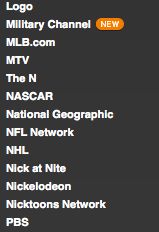 Remember the public split between Apple and NBC a few months back?
NBC wanted to jack up the prices for TV show downloads via iTunes from $1.99 per episode to $4.99. In response, Apple announced that it would not be selling NBC television shows for the upcoming television season in iTunes.
NBC & Apple’s agreement ends in December. As a result, NBC and affiliated NBC Universal channels are no longer listed at the site (right).
Paid downloads of TV shows have failed to make much of an impression with digital media fans, despite the runaway success of iTunes’ music store. The mediocre resolution of current video downloads may turn off some buyers, while others balk at the idea of paying for content that was originally distributed for free.
TV Is Changing Shape
Dec 2nd, 2007 | By James Lewin | Category: GeneralThe New York Times has an overview of the state of mainstream Internet video today that asks “What happens to the television industry when the traditional way for content to find its audience becomes obsolete?”:
“There’s a lot of rewriting of the concept of windows in the TV network world today — the timing of when and where shows appear,” said Allen Weiner, the managing vice president for media and consumer technologies for the Gartner Group in Scottsdale, Ariz.
In the old days, after something appeared on TV, its release to other distribution channels was carefully staged — from the timing of reruns to the DVD release to when it would be available on-demand. “We’re seeing all kinds of new windows occurring, and no one knows what the magic formula will be,” he said. “A lot depends on advertiser reaction and on user behavior.”
One closely watched approach is the new online series “Quarterlife,” by Marshall Herskovitz and Edward Zwick, who produced “My So-Called Life.” Episodes first appear on MySpace TV, then are available the next day on Quarterlife.com, and a week later on YouTube, Facebook and Imeem. There is talk that they may even appear later on network TV — but as the last window, rather than the first.
‚ÄúYou can‚Äôt expect to control consumers and force them to come to prime time at 7 p.m. on a Monday night,‚Äù said On Network’s Kip McClanahan. ‚ÄúIf the consumer wants it on their phone at 3 p.m. while they‚Äôre on the golf course, then that‚Äôs where we have to deliver it.‚Äù
Unfortunately for viewers, the industry is years away from making this a mainstream reality. Meanwhile, indie video podcasters and vloggers are pioneering the way, making their content freely available on multiple platforms, DRM-free.
