Latest News
ADM Proposes Downloadable Media Audience Measurement Guidelines
Apr 21st, 2008 | By Elisabeth Lewin | Category: Audio Podcasting, General, Making Money with Podcasts, New Media Organizations, Video Podcasts  The Association for Downloadable Media, a recently-formed industry association “focused on creating standards and guidelines to support the continued and increasing monetization of downloadable media,” last week unveiled proposed guidelines for audience measurement at the ad:tech conference in San Francisco. The draft proposal is open for public discussion and comment for the coming thirty days (through May 16).
Explaining the audience measurement guidelines and discussing the rationale behind their creation were three panelists who were among the several dozen committee members involved in the drafting process: Stephen Smyk, Performance Bridge; Angelo Mandato, CIO, Raw Voice (and Chairman of the ADM Measurement Committee); and Daniel Rioux, SVP, Media Director, Campbell-Ewald.
Here is a brief synopsis of their presentation:
Need for download measurement:
Throughout the downloadable media/podcast industry there is a need for download measurement. This need impacts us all, from veteran podcasters, to “amateur content producers,” to what we consider more traditional media.
Need for measurement standards:
Coming up with some standards for how we count/measure downloads would provide confidence for ad buyers (“so we’re all measuring apples-to-apples”). Committee members agreed to utilize existing measurement methods where possible, while also proposing and adapting standards for future measurement methods. For all of these, analysis of data is required.
Sources of measurement data:
“native server” (where the downloadable media is hosted) measurement, and
“third party” measurement (measurement by an intermediary server between the content creator and another third-party server). This third-party can uniformly measure across multiple native servers (from own server, from Libsyn, etc.).
Much of the data used for gauging audience size can be gleaned from server log files. Some things that can be measured include
From Third party and native servers
IP address
Time stamp
HTTP: status code
referrer
user agent (tells where download occurred: browser, podcatcher, web bot)
byte range
From Native servers only
Bytes served
Some Analysis Factors to Consider:
IP address (proper filtering based on IP address – so 1 person doesn’t download multiple times)
Time Stamp – when time frame of download occurred
HTTP: status code
Bytes Served
Referrer
Byte Range
Analysis Methodologies
Methodologies Available to Buyers
ADM Compliant Publishers
Minimum Recommendations
IP Address Analysis
Advantage
Methods that best fit the publishers’ situation
ADM Measurement Committee chair Mandato explained that the ADM Ad Council, comprised of seasoned veterans in the digital/online advertising industry, also reviewed the measurement guidelines document, “to make sure that we have a complete document. In weeks to come,” he said, “we are going to create a standards/terminology document, to further explain the terms.”
The draft audience measurement guidelines are open for public review and comment for the coming month.
More of the panel presentation, on case studies and the ad agency’s perspective on audience measurement, after the break —
Read more »
The Zunetanic Revisited
Apr 21st, 2008 | By James Lewin | Category: Digital Music, iPods & Portable Media Players 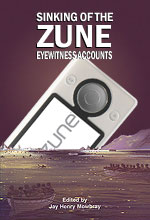 Molly Wood has a great take on the state of the Zune over at Crave, offering 5 reasons she’s leaving the Zune behind and a scary tale about how her Zune erased thousands of her songs:
About two weeks ago, I was going on a trip. My Zune’s battery had run out, so I plugged it in to charge it to take on the plane with me. Despite my settings in the Zune software not to sync all my music, video, pictures, and podcasts, the Zune started its sync dance.
When it was complete, it gave me this message:
10 items added
2,372 items removed
WHAT!!!???
Yep. The software, in its auto-sync wisdom, removed every single song from the device that was not stored locally on the computer. There was no prompt, there was no “I can’t find this” warning like the iTunes Library will sometimes offer. It just decided, out of what I assume was some misguided antipiracy effort, to remove any songs that it couldn’t find on my hard drive. What if I were syncing the machine with two different computers with two different music libraries, you ask? Too bad. Zune is in control.
And you know what? I don’t like being told what to do. I don’t like sitting on a wiped Zune two hours before I’m supposed to leave from the airport. I don’t like software that ignores what I think is a pretty specific request for manual syncing, and I don’t like device behaviors that assume I am stealing music. What this all boils down to, I’m truly sorry to say, is that I don’t like my Zune. Hello, again, little iPod buddy.
Any media player is going to have its bugs and quirks. Unfortunately, Microsoft has failed to make the Zune’s bugs and quirks worth putting up with.
Radio Survey Finds Audience For Podcasting Up 87%
Apr 21st, 2008 | By James Lewin | Category: Podcasting Research, Podcasting Statistics  According to the most recent Tech Poll from radio research firm Jacobs Media, the audience for podcasts is up 87% year to year among rock radio listeners.
Here are some of the highlights of their research:
- New technology continues to rapidly move into radio listeners’ lives. This year, the “big gainers” in terms of occupying their time includes streaming video, iPod ownership (and podcasting), and text messaging. Almost the entire sample now owns a cell phone and has access to a hi-speed Internet connection.
- In-home radio listening is declining, as respondents continue to utilize other media in their residences.
- A variety of things are cutting into people’s time listening to radio:
- Reading news online
- Social networking sites (continuing to grow)
- iPods/mp3 players (getting bigger every year)
- Podcasting (up 87% year to year)
- Streaming radio
- Music sites like Pandora, iTunes
- Video games (which was trending down last year)
- Cell phones (which continue to be huge)
- DVDs
- TiVo/DVRs (which leads to more television viewing)
- Video sites like YouTube
- Nearly six in ten respondents own a iPod/portable media player, an increase of 23% over last year’s poll. And the iPod’s presence in cars continues to rise.
- HD Radio is going nowhere fast – awareness is limited to about 1 in 100 people surveyed.
- Three in ten (28%) respondents (whether they own an iPod or not) say they’ve downloaded/listened to a podcast.
- Two-thirds (69%) of those listening to podcasts are very or somewhat willing to access a free podcast that contains an introductory commercial from a sponsor.
Read more »
New Mac App Automates Audio File Processing
Apr 19th, 2008 | By James Lewin | Category: Podcasting Software 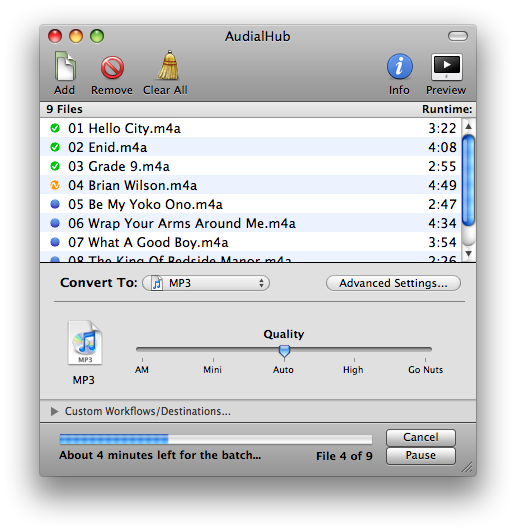
Techspansion has introduced AudialHub — an inexpensive Mac app designed to convert dozens of different audio formats (and the audio tracks from video files) to AAC, MP3, WMA, WAV and Apple Lossless formats, with the standard metadata tags in most formats converted and passed on to the finished file.
Nearly every aspect of the decoding and encoding workflow is available for tweaking. A dynamic Preview panel allows for quick playback checks. Multiple queues — all with their own separate settings — can be run simultaneously.
Key Features:
- Conversion from dozens of audio types to popular formats like AAC, MP3, WMA, AIFF, WAV, Apple Lossless, 3G (cell phones), Ogg Vorbis, FLAC, and Audio and MP3 CDs.
- Audio tracks inside video files can also be converted.
- Common tags (Artist, Album, etc) are automatically passed when applicable.
- Up to 16 hours of audio can be converted to a single MP3 CD.
- Easy-to-use Trim capabilities to narrow down short segments of audio.
- Quick Preview capability to check out compression quality and Trim settings before a full conversion.
- Dynamic file queue, allowing mid-conversion changes or additions, Pause/Resume, and an “always ready” Assembly Line Mode.
- Run multiple simultaneous conversions in separate queues with separate settings.
- Growl notifications, Dock progress indicator, and AppleScripting automation support!
- Normalization, audio track selection, multiple decoder options, and direct access to add custom low-level command-line settings.
- Detailed Users Guide and Help Center.
AudialHub is available immediately for $18.81 USD. A free trial is available.
Exposé Highlights The Problem Of Indentured Blogitude
Apr 18th, 2008 | By James Lewin | Category: Strange
Last week, the venerable New York Times blew the cover off the shocking world of 24/7 blogging, where bloggers blog until they drop…….if not sooner.
Now, BarelyPolitical has gone undercover to reveal the tragedy of indentured blogitude, a problem that until now has gone completely unnoticed.
And if it’s happening in the world of blogs, can bet that there are tyrannical podmasters creating cast systems that turn innocent podcasters……..into untouchables.
What Do You Think About The ADM’s Standards For Downloadable Media?
Apr 18th, 2008 | By James Lewin | Category: Making Money with Podcasts  The ADM, an industry group focusing on commercial downloadable media, is looking for feedback on its proposed Advertising Unit Standards (pdf) and Download Measurement Guidelines (pdf), which were released this week at ad:tech San Francisco.
The purpose of the Advertisement Unit Standards is to provide baseline recommendations for advertisement units in order to better facilitate advertising transactions relating to downloadable media.
The purpose of the Download Measurement Guidelines are to establish baseline recommendations for how individual publishers, companies and organizations can measure how downloads are delivered to consumer audiences.
What Do You Think?
You can provide feedback to the ADM three ways:
1. Enter your public statements in the comments section in the document comments pages:
2. Send your confidential statements to info@downloadablemedia.org
3. Send your confidential statements via mail to:
The Association for Downloadable Media
611 Pennsylvania Ave, SE #164
Washington, DC 20003-4303
I’d be interested in your thoughts on ADM’s proposals, too. Let me know what you think in the comments!
Odeo Back In Beta
Apr 18th, 2008 | By James Lewin | Category: Audio Podcasting, Streaming Video, Video Podcasts 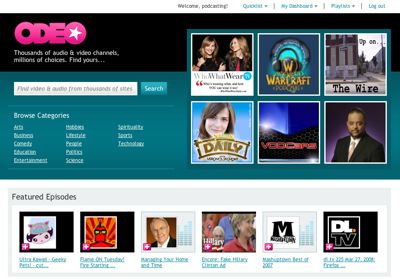
Odeo, an early podcasting startup that has long struggled with its direction, is back, in beta and looking for feedback.
While the original site focused on podcast creation, the focus of Odeo’s latest incarnation focuses on viewing and listening to Internet media.
Give it a look and let me know what you think of the makeover!
ADM Announces Proposed Advertising Standards
Apr 17th, 2008 | By Elisabeth Lewin | Category: Audio Podcasting, Digital Music, Digital Video Downloads, General, How to Podcast, Internet TV, Making Money with Podcasts, New Media Organizations, Video, Video PodcastsThe Association for Downloadable Media, an industry group focusing on podcasting and new media, today unveiled proposed advertising standards for use with downloadable media. The proposed ad units are offered with an eye toward making negotiations smoother between content creators and advertisers.
The proposed standards were presented Wednesday morning in an ADM forum at the ad:tech convention in San Francisco, by a panel of people who helped develop the standards.
 Presenters included:
- David Hamilton, the President and CEO of Backbeat Media, and member of the ADM Advertising Standards Committee;
- David Herscott, President of MEA Digital and the appointed Chair of the ADM Ad Council; and
- Sean Cheyney, CMO of AccuQuote.
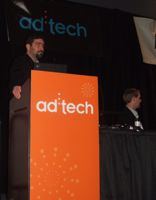
- The talk was moderated by Bryan Moffett (pictured), Director of Ad Operations, Natl Public Media, and ADM Membership Committee Chairman.
The draft ad units cover a range of standard advertisement sizes and types and formats, and also include a “collaterals” category, for other podcast advertising “real estate” not necessarily covered in the other unit definitions.
Why Do We Need Standards For Downloadable Media?
Dave Hamilton tackled the question, “Why come up with standards?”
He explained that he has bought ads in podcasts, sold ads in podcasts, and so on, but across the many podcasts, among many different sponsors, there were lots of different advertising options – and the potential for lots of confusion.
The Ad Standards Committee and the Ad Council sought to come up with some podcast ad-unit guidelines like those of the Internet Advertising Bureau (IAB) for its display ad units. Their “rules” in developing these standards were to keep options alive, exclude nothing, knowing that different people will use different methods and so forth.
The group strove to make any standards they developed simple (easy to understand), and inclusive (exclude nothing).
Here’s what they came up with….
Read more »
LonelyGirl15 Creators Get $5 Million For EQAL Startup
Apr 17th, 2008 | By James Lewin | Category: Podcasting Networks, Video, Video Podcasts, VlogsEQAL, the faux reality show startup of LonelyGirl15 creators Miles Beckett and Greg Goodfried, has raised $5 million in capital to help it produce new shows and international versions of its show:
Per Becket & Goodfried:
We’ve spent the last year and a half working hard at producing lonelygirl15, launching KateModern, and figuring out a business model that works in this emerging medium. None of it would have been possible without the help of our incredible team and our amazing community of hundreds of thousands of passionate viewers. Of course, you all know the actors on each show, but you may not know James, Amanda, Kelly, Casey, Luke, Kevin, Yusuf, Marcello, and the entire lonelygirl15 and KateModern production teams without whom none of this would be possible. We are incredibly fortunate to be working with such an all star group of individuals.
It’s an exciting time for online entertainment. There are a slew of independent producers, digital studios, and social media companies sprouting up, not to mention the fact that traditional media isn’t exactly ignoring this whole “internets†thing. We’ve always wanted to stay independent and produce interactive shows that we could put our hearts and souls into, and sometime last fall we realized that raising money would give us the ability to remain independent and produce amazing shows on our terms.
After six months of fast food and airplane delays, we found a VC that shared our vision to build a company that would produce truly interactive shows. Many of the exciting innovations we’ve all talked about will finally come to fruition now that we have the funding to act on our shared vision. Needless to say, we’re very excited to get started.
No investors would have put a cent in this company without the passionate and amazing community that has formed around LG15. A sea change is under way, and you are all at the very beginning. We are so excited to take this ride with you and see where it will lead.
Who’d have thought a video series co-starring a purple monkey puppet would come so far?
Trends are favorable for new media content producers: people are moving their attention from television to Internet media; the audience for new media is exploding; and there’s a flood of advertising money ready to wash into new media.
Audience For Audio, Video Podcasts Way Up
Apr 16th, 2008 | By James Lewin | Category: General  The audience for podcasts is way up, according to the latest research by Arbitron/Edison Media Research.
Their study, The Podcast Consumer Revealed, found that:
- The audience for audio podcasts grew 38% in the last year;
- The audience for video podcasts grew 45% in the last year;
- About 30% of regular Internet users have downloaded a podcast;
- Awareness of podcasting has leveled off at about 37;
- People listen to or watch podcasts primarily on their computers (about 75%).
Podcasts Offer Marketers New Opportunity To Reach Listeners
Edison also found that podcasting was creating new opportunities for marketers to reach listeners:
- Podcast listeners spend nearly 25% more time listening to Internet audio than average;
- Podcast listeners spend an average of 7 hours and 50 minutes per week listening to Internet audio, compared to the overall overage of 6 hours and 20 minutes.
“Users continue to prove that they want to consume radio on their terms,” said Tom Webster, vice president, Edison Media Research. “On-demand media and a wealth of portable devices are creating listening occasions that were previously either unavailable or under-utilized, which is increasing the overall demand for audio content.”
Read more »
