Latest News
1-Click Podcast Subscriptions For The Microsoft Zune
Oct 25th, 2007 | By James Lewin | Category: How to Podcast, iPods & Portable Media PlayersPodcaster, mobilecasting guru and Zune Podcast Programming Manager Rob Greenlee has announced 1-click podcast subscriptions for the Zune portable media player.
The 1-click process will launch the Zune Marketplace software and add the podcast subscription to the user’s collection. The process will work best if the Zune user already has the new Zune Marketplace software loaded on a Windows PC. If not installed, the user will be prompted to download the software. The podcast feed does not need to be in the Zune Marketplace for the link to work.
How To Set Up 1-Click Podcast Subscriptions For The Zune
Create the 1-click link URL using this format:
zune://subscribe/?PodcastTitle=PodcastRSSFeedURL
Here is a working example:
zune://subscribe/?wallstrip=http://feeds.feedburner.com/wallstrip
In this example, PodcastTitle is wallstrip and PodcastFeedURL is http://feeds.feedburner.com/wallstrip
Spaces between words in the PodcastTitle will work fine.
Here is Microsoft’s official hyperlink image for use for Zune 1-click subscription process:

“We are building a great podcast service offering,” adds Greenlee, “that should more than fill the needs of podcasters and Zune 4, 8, 30 and 80 users.”
Apple OS X Leopard Adds Podcasting, New Media Features
Oct 25th, 2007 | By James Lewin | Category: Podcasting SoftwareApple releases the latest version of its operating system, OS X, tomorrow. While the update offers more than 300 new features, most of them are incremental improvements.
There are also quite a few head-scratchers in the update. Do we really need birthday templates for email? We’d rather see Apple fix email, which is currently crippled by spam. Backgrounds for iChat? We’d rather see iChat integration with more Internet communication services, like Skype. Translucent menus & stacks? Pretty, boring.
For podcasters, though, OS X Leopard includes some features that may make the upgrade something to get excited about. Here are some of the top new features for podcasters and new media users:
Front Row
AppleTV has received a lot of criticism since its introduction, despite the fact that it makes a great peripheral for video podcasts. Critics would like to see Apple add a DVD player to Apple TV, include a bigger hard drive, let you control your Internet TV subscriptions directly from AppleTV, and have the device get content directly from the Internet.
In other words, a Mac mini with AppleTV’s interface.
With the new version of Front Row, Apple is turning every OS X computer into an Internet media center. It offers a simple interface to DVDs, your music library, photos, podcasts, video podcasts and other digital media. It will also let you view content from other iTunes libraries on your home network.
iChat
iChat recording is designed to make it easy to record audio and video discussions. iChat asks your contacts for recording permission before the chat starts, then stores completed audio chats as AAC files and video chats as MPEG-4 files. Yep – ready for podcasting.
We’d like to see iChat learn to play well with others, but with more and more people switching to Macs, especially in new media, this may become less of a concern.
Photo Booth
Photo Booth is a stupidtacular app. It’s really pretty useless and can eat up hours of your time.
Still – the fun-house effects can be hysterical.
Now you can record short videos with photo booth. Useless and time-wasting, yes. But probably hysterical, too.
Podcast Capture
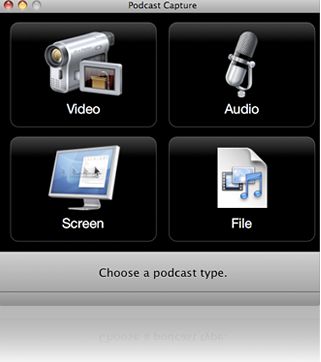
With Leopard, Apple includes Podcast Capture & Podcast Producer.
Podcast Capture is designed to make it easy to capture high-quality audio and video from local and remote cameras and record screen captures. Podcast Capture records audio and video from a wide range of devices, including digital video cameras connected via FireWire, USB microphones, and iSight cameras.
Once captured, you can upload content into Podcast Producer for encoding and distribution.
Podcast Producer is designed to simplify the process of recording content, encoding, and publishing podcasts for playback in iTunes and on iPod, iPhone, and Apple TV. Podcast Producer leverages the power of QuickTime to encode content into standard formats such as H.264 and MPEG-4.
Podcast Producer includes a dozen built-in workflows to automate publishing of podcasts to blogs, iTunes, iTunes U, or even multimedia-enabled cell phones over high-speed wireless networks using QuickTime Streaming Server. Workflows include the ability to archive recordings, apply custom Quartz Composer compositions with titles and watermarks, add opening and closing videos, notify the iTunes Podcast Directory of the new episode, and send out an announcement email.
Podcast Producer uses Xgrid distributed processing technology for large-scale podcast productions — encoding tasks are automatically distributed to other servers. All that is required is another server running Podcast Producer and a shared file system such as Xsan or NFS.
Podcast Capture/Producer’s focus appears to be on large podcasting operations, such as universities, where automation and workflows can be used to capture and podcast things like lectures.
Scoble: PodTech Not Dead Yet!
Oct 25th, 2007 | By James Lewin | Category: Digital Video Downloads, Internet TV, Podcasting Networks, Video Podcasts 
Struggling podcasting startup PodTech isn’t closing up shop, according to PodTech VP Robert Scoble. It’s changing direction.
“Reports of PodTech’s demise are bull####!” said Scoble. “This is total, 100% bull####. Not even deserving of a response. I’m not leaving PodTech. When, er if, I am you’ll read it here on my blog.”
Daniel Lyons, writing as Fake Steve Jobs, says PodTech is “heading for the big sleep.”
“Hard to believe PodTech is going under, because they seemed to have such a solid business model,” writes Lyons. “Find people who don’t have much of anything significant or entertaining to say; film them doing this; then sell advertising against the content. What’s not to love?”
PodTech isn’t dead yet – but it looks like there are people lining up to give them a blow to the head.
VeriSign and Bamboo MediaCasting Team to Deliver Mobile Podcasting Service
Oct 24th, 2007 | By James Lewin | Category: Mobile PodcastingVeriSign and Bamboo MediaCasting, a mobile content delivery solutions provider, have teamed to offer VeriSign Mobile Media Cast, a managed mobile podcast service for wireless operators.
The VeriSign Mobile Media Cast is a fully managed solution which provides operators the ability to deliver licensed podcast content to their customers, with complete life-cycle management of the content handled by VeriSign. The channel-based subscription model allows subscribers to select the content they desire, and then enjoy the media without browsing or network connection.
Podcasting has struggled to get a foothold in the world of cell phones, in part because the complexity of set up on devices with limited interfaces. The most successful mobilecasting solution is arguably the iPhone, which offers a richer interface and relies on computer-based podcast management.
Read more »
ShredOrDie Wants To Be The YouTube Of Extreme Sports
Oct 24th, 2007 | By James Lewin | Category: Internet TV, Streaming Video, Video  ShredOrDie.com, a new website that wants to the be YouTube of extreme sports, launched today. The site is a collaboration between the creators of funnyordie.com and skateboarding icon Tony Hawk.
ShredorDie.com features action sports videos, with an emphasis on skate, snow, surfing, BMX, motocross and action sports culture. Tony Hawk provides creative direction and a bit of extreme sports star legitimacy. The site makes use of a “shred” or “die” voting system designed to uncover and highlight the best possible content.
“I’m excited to be a part of Shred or Die because I like the idea of creating a site where action sports fans can find content from professional and non-professional athletes, as well as creating their own and sharing it. The action sports community has a unique camaraderie and I want our site to reflect that,” said Hawk.
“I have also been interviewing various celebrities during my extensive travels, creating clips called ‚ÄòDissent TV,‚Äô” added Hawk. These include athletes, artists and actors like Lance Armstrong, Shaun White, Ryan Sheckler, Ed Helms, Bam Margera, Christian Slater and Isaac Brock, all of which will be exclusive to ShredorDie.com. ‚ÄúDissent TV‚Äù will be a regular feature on the site.
The meat and potatoes of the site, though, are extreme sports videos, like this chestnut of Mike “Rooftop” Escamilla doing tricks while on fire:
Google, Nielsen Partner To Track Video Usage
Oct 24th, 2007 | By James Lewin | Category: Internet TV, VideoGoogle and the Nielsen Company announced today a multi-year, strategic relationship. As a first step, the relationship leverages Nielsen’s experience in television audience measurement to bring demographic data to the Google TV Ads advertising platform.
By combining Nielsen demographic data with aggregated set-top box data, Google hopes to provide advertisers and agencies with comprehensive information to help them create better ads for viewers and maximize the return on their advertising spending.
“As we continue to expand our TV advertising program, it is important that we provide advertisers and agencies with data that will help them reach their target demographic with the right ad,” said Eric Schmidt, chief executive officer at Google. “Working closely with Nielsen, the industry leader, improves our measurement capabilities by adding a demographic layer on top of existing set-top box data. We’re pleased that Nielsen is working with us in this endeavor.”
The partnership reflects broader trends of using technology to deliver more intelligent, targeted video advertising and the integration of online and offline data.
Read more »
New Paid Podcast Service Introduced
Oct 23rd, 2007 | By James Lewin | Category: Podcasting Services  SubscribeCast Technologies has released Preeso, a new Web-based service for creating premium (paid) podcasts. The service is a ground up redesign of the company’s existing premium podcasting application.
‚ÄúWe really focused on the user experience. We want the customer to be able to set up a paid and protected podcast in minutes, not hours, or days,‚Äù said Chris Wolf, SubscribeCast‚Äôs Director of Client Relations. “Preeso takes premium podcasting and makes it an easy option for anyone to implement.”
The site offers a free “Lite” version and a $2O/month “Pro” option. After registering, you tell Preeso where your podcast files are, and then you can begin distributing your content through protected subscriptions. The Pro option offers advanced reporting and the ability to use an API to integrate the service with your site.
The application also hides the original web location of the delivered media, so subscribers cannot use their old RSS feed to mine the URL and access media after their subscription has ended.
Expressivo Reads Your Text & Puts It On Your iPod
Oct 23rd, 2007 | By James Lewin | Category: General, iPods & Portable Media PlayersA new version of Expressivo text-to-speech software has been released. New with version 1.3 is integration with iTunes, making it easy to automatically translate text-to-speech and get it on your iPod.
Any text read by Expressivo is automatically added to your iTunes library as an audio file. Texts read by Expressivo can also be played on other MP3 players, cell phones and palmtops.
You can preview Expressivo’s text-to-speech translation online.
New Revver Plugin Pairs Video With WordPress Blogs
Oct 23rd, 2007 | By Elisabeth Lewin | Category: Making Money with Podcasts, Video, Video Podcasts  Video sharing platform Revver now has a WordPress plug-in for users of the popular blogging application. Revver takes user-created video content, pairs it with targeted advertisements, and shares the revenue with the video’s creator. They also have an existing set of developer tools for non-WordPress users, for making video sharing websites.
Podcasting News took a look at Revver’s WordPress plug-in at last month’s Podcast and New Media Expo. We were excited by what we saw during Richard Frias’ demonstration. According to Frias, Revver’s Content Acquisitions Coordinator, the plug-in allows WordPress bloggers to create their own video environments, and upload video right through their WordPress blog interface.
Frias also added that, using this WordPress plug-in on your blog, visitors can make their own video responses and upload them, much like leaving written comments on a blog post. The blogger makes 20% off these video responses (the remainder is split between Revver and the creator of the video response). “This will ‘incentivize’ people for syndicating and sharing video,” Frias said. “I’m excited to see what people will do with this.”
Some beta testers of the Revver WordPress plug-in include I Can Has Cheezeburger? video site LOLCats.TV , non-partisan celebrity/politics site (Joe Pantoliano talking about the Constitution? Cool!) Constitution Live!, and quirky vlog Happy Slip. It may be just us, but it seems to work better with Safari than with Firefox in this beta version.
Revver’s WordPress plug-in is currently available (in a beta version) on its site. Revver’s Software Engineering VP, Asi Behar, reports that “we are looking to release a new version shortly with some more customization options as well as support for hosts that make external API calls difficult – that should be coming out in the coming days.”
Is YouTube Screwed?
Oct 22nd, 2007 | By James Lewin | Category: Internet TV, Streaming Video, VideoAt GigaOm, Om Malik is starting to ask the same question we’ve been asking, now that big media is pulling its content off YouTube, developing their own video sites and ganging up to fight YouTube:
Is YouTube screwed?
“It is becoming increasingly obvious: Big media companies (content owners) are lining up against YouTube & Google, and are coming up with their own strategies for online video,” writes Malik. “There is a clearly fear of Google on the part of large content companies, while at the same time, a desire to build their own online video properties.”
Mainstream media has long had an uneasy relationship with YouTube. Now, it looks like big media’s plan is to:
- Yank their content off YouTube
- Gang up to fight for tighter copyright enforcement at user-generated media sites like YouTube
- Sue YouTube for billions
- Offer an alternative to the low-quality, poorly indexed content at YouTube
Malik thinks that it’s a mistake to try and compete with YouTube. “It is my belief that these companies are in the business of content, not distribution,” writes Malik.
The problem with Malik’s logic, though, is that on the Internet, publishing is distribution.
Podcasters and video podcasters know this. Andrew Baron and Cali Lewis and the Ask A Ninja guys know that they can publish a video in the morning and have a global audience by noon.
The media companies know this, too. They can make video destination sites, like the new Daily Show site, and know that the show’s fans will be glad they don’t have to wade through spam videos, bad parodies, foreign-language weirdness and lonelygirl15 to get to their Jon Stewart fix.
Big media knows, too, something else that indie podcasters have found out: there’s not much benefit in letting YouTube control your relationship with your audience. Bloggers want to control their relationship with readers, podcasters want to control their relationship with listeners, video podcasters want to control their relationship with viewers, and it’s not a surprise that traditional media wants to follow suit.
Big Media Is Gearing Up To Screw YouTube
It’s pretty clear that big media is gearing up to screw YouTube. It’s probably inevitable that the attention of Internet video fans will move from centralized portals like YouTube to finding video published all over the Web using video search sites. The big media companies see this coming and are going to try to speed the process along by gutting YouTube.
This doesn’t mean that big media’s decision to dump YouTube is without risk, though. While the Daily Show’s site is pretty cool, expect a lot of lame big media video sites until the industry builds some consensus about what makes a video site great. Expect Google to put a lot of its brainiacs to work, too, looking for ways to protect its billion-dollar plus investment in YouTube.
If big media really wants to screw YouTube, without screwing its audience, it will:
- publish more content to the Web, faster, than YouTube;
- publish video at a higher quality than YouTube;
- make it easier to find videos than at YouTube, by offering comprehensive search and indexing by things like year, episode titles, stars, topics, character names and famous lines;
- make embedded video as permanent as URLs – YouTube embeds are notoriously unreliable;
- control content and control the relationship with viewers, but not try to control viewers;
- offer ad-supported video-podcasts;
- use YouTube and other sites as promotional tools;
- use minimal, targeted advertising; and
- be patient while audiences build and advertisers move their budgets to the Internet.
