Latest News
Wizzard To Use Adobe Media Player For Video Podcasts
Apr 9th, 2008 | By Elisabeth Lewin | Category: Podcast Distribution, Streaming Video, Video, Video Podcasts  Wizzard Media is working together with Adobe to distribute video content from their network through the new Adobe® Media Player. Launched today, the Adobe Media Player is the first application built on Adobe AIR software, a cross operating system application platform that extends rich Internet applications (RIAs) to the desktop.
The first installment of video podcasts from the Wizzard Media Network will include The Hilary Duff Video Podcast, Tiki Bar TV, Hot for Words, Average Betty, Hawaii Surf Session Report, Midwest Teen Sex Show, Lynchland, and Underbelly, with more programming being made available soon.
The Adobe Media Player gives viewers the ability to watch video podcasts from the Wizzard Media Network in Adobe Flash format, either online as streaming video or by downloading the content to view offline, in full-screen playback, from the desktop. The new player has a subscription feature, and publishers are also given the opportunity to distribute, measure and build businesses around video content.
“We take pride in having our content featured at the launch of this innovative new media player, and are invigorated by the path Adobe is blazing in the arena of combining streaming and downloadable video into one application,†said Chris Spencer, CEO, Wizzard.
â€Wizzard Media offers viewers a variety of programming through their popular podcasting networks,†said Ashley Still, senior product manager for Adobe Media Player at Adobe. “We’re delighted to collaborate with Wizzard Media and include their wide range of shows into Adobe Media Player.
Are Podcasters Madison Avenue’s Worst Nightmare?
Apr 9th, 2008 | By James Lewin | Category: General 
The Salt Lake Tribune has an interesting article that takes a look at the guys behind the wildly successful video podcast, WillItBlend?
George Wright and Tom Dickson have managed to do two things on the Web that advertising execs worldwide have yet to achieve: launch a successful viral video campaign – and make money from it.
“We’re Madison Avenue’s biggest nightmare,” says Wright, marketing manager at Orem-based Blendtec Inc.
That’s because the Blendtec campaign contradicts the conventional wisdom of online viral marketing experts. For Blendtec, there was no long-term strategic plan, just a fun and happy accident, a measure of good humor, and lots of plain common sense.
The article also includes comments from marketers that promise to help companies make their own viral hit:
“The Wild West days of [early viral hits] Lonely Girl and ‘Ask a Ninja’ are over,” says Dan Ackerman Greenberg, co-founder of the West Coast-based video marketing company Comotion Group.
“You simply can’t expect to post great videos on YouTube and have them go viral on their own.”
There’s no shortage of new middle men. “ViralTracker.com” offers to “track the reach and response of your viral campaign with the accuracy of a Swiss watch.” ViralVideoCompany.com claims companies can achieve significant market penetration “without spending a pretty penny,” something Christine Beardsell, a leading analyst of online video at Incisive Media, says “is just plain naive.”
Based on Blendtec’s experience, though, the idea that you have to spend a pretty penny to get people to watch your video may be “just plain naive’…..
Read more »
New Adobe Media Player Could Change Internet Television
Apr 9th, 2008 | By James Lewin | Category: Internet TV, Podcasting Services, Streaming Video, Video 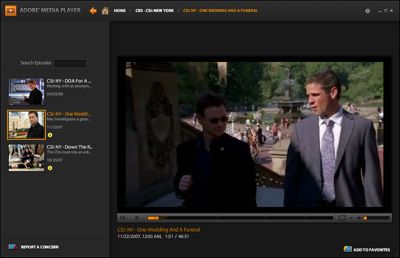
Adobe today announced the immediate availability of Adobe Media Player 1.0 software, a app built on Adobe AIR that could significantly change the world of Internet media.
Adobe Media Player is a cross-platform media player that is being distributed by Adobe, but that can also be distributed as a “branded” player by publishers. Major television broadcasters and leading content publishers, including CBS, MTV Networks, Universal Music Group, PBS, CondéNet, and Scripps Networks have worked with Adobe to provide a broad range of television programming and entertaining video content to viewers.
Adobe has also announced Adobe TV, a network in Adobe Media Player that offers a series of shows focusing on Adobe creative media products.
“It’s a merger of TV Guide and DVR for Internet video content. Some great shows, like The Hills from MTV and CSI from CBS, is already available to view and more will be coming soon.†said John Loiacono, senior vice president of Creative Solutions at Adobe.
HD In Flash, Video Podcast-like Subscriptions
Adobe Media Player can provide high-quality playback of streamed, downloaded or locally-stored video in the Adobe Flash format. For the first time, consumers can download video outside the browser in the Adobe Flash format, which can be viewed in 1080p, 720p or 480i video display resolutions.
Users can also subscribe to television shows and other online video content and then automatically receive new episodes of the shows as they become available.
To help viewers discover new content, a broad, searchable catalog of shows from leading media companies and networks is available. Some of the initial content available on Adobe Media Player includes:
- CSI: New York
- CSI: Miami
- Big Brother
- Star Trek
- Melrose Place
- Hawaii Five-O
- The Twilight Zone
- MacGyver
- The Hills
- MTV News
- Yo! MTV Raps
- Select shows on HGTV, Food Network, DIY Network and Fine Living Network
- Epicurious.com, Style.com and Wired.com from CondéNet
- PBS programming
- Music videos from Universal Music Group.
- Additional content from MTV Networks’ brands including MTV, Nickelodeon, COMEDY CENTRAL, VH1, CMT, Logo, Spike, The N, GameTrailers and Atom Films will be made available over the next several months.
The ubiquity of Adobe’s Flash combined with a growing body of content and branded layers could make this a major platform for online video.
New Revenue Models for Content and Media Publishers
Adobe Media Player is also creating a platform for making money from free subscription content.
According to Adobe:
Adobe Media Player enables viewers to subscribe to free content, giving them control to watch their favorite shows both online and offline. The player also offers next-generation offline monetization and branding options, including viewer-centric dynamic advertising for targeted marketing campaigns and the ability to customize the look and feel of the player to match the brand or theme of the video content. Adobe Media Player can also provide content publishers with anonymous measurement of content usage data, such as when and how often a video has been viewed, in addition to supporting protection options such as protected streaming, advertising protection and video DRM protection.
This is what a lot of publishers want – but it will limit playback to supported platforms.
Availability
Adobe Media Player is immediately available as a free download for Windows and Macintosh.
South Park On Monetizing Internet Media
Apr 9th, 2008 | By James Lewin | Category: Making Money with PodcastsCan you argue with that?
flickr Wants To Be The New YouTube
Apr 8th, 2008 | By James Lewin | Category: Streaming Video, Video
Video on flickr just got official – at least if you consider an announcement by puppets to be official.
The service is limited to pro accounts and videos are limited in length to 90 seconds. Here’s what flickr has to say about the 90 second limit:
Video on Flickr grew out of the idea of “long photos†and as such, we’ve implemented what might seem like an arbitrary limit of playing back the first 90 seconds of a video. 90 seconds?
We’re not trying to limit your artistic freedom, we’re trying something new. Everyone has endured that wedding video, where even the bride will fast-forward to the “good bit.†In fact, even Tara at FlickrHQ hasn’t made it past the first 90 seconds of her own wedding video.
It’s hard to say who this is targeting; it looks like flickr may be getting their feet wet before doing a larger roll-out that is more competitive.
What do you think? Are you going to use flickr video?
LibSyn Stats Pains Continue
Apr 8th, 2008 | By James Lewin | Category: General  LibSyn‘s stat problems continue to plague users of this popular podcast hosting service.Â
Here’s their latest update on the issue:
Latest episodes not showing up in stats
We have temporarily stopped the stats engines- meaning no new updates of any files will occur for the time being. We are working on a plan to recover the data for those users affected over the last several days worth of data.
We do not want to jump the gun on pointing the finger for what happened, it would seem that the recent interruptions with Amazon EC2- which we take advantage of for our stats processing- has caused some unexpected behavior. This would also account for why a swath of users across only some of the partitions were affected.
LibSyn’s stats problems have been going on for months; this is a showstopper for many serious podcasters.Â
Â
iPhone Doubles Its Share Of The Browser Market
Apr 8th, 2008 | By James Lewin | Category: General  The iPhone is rapidly increasing Apple’s share of the browser market, according to the latest figures from StatCounter.
About 1 in 400 browsers on the Internet are now using Safari on the iPhone or iPod touch.
- Apple increased its share of the Internet browser market in the US by 64% between December and March, according to StatCounter,
- In March, iPhone and iPod touch increased their share of the total browser market in the US from 0.14% in December to 0.23%.
- Globally iPhone/iPod touch has more than doubled its share of the Internet browser market from 0.03% to 0.08%.
“The key message is that iPhone is more than living up to its claims of being a user friendly Internet browser, unlike many other cell phones,†commented Aodhan Cullen, founder and CEO of StatCounter.
We’ve said previously that Apple’s mobile Safari is likely to have a 1% browser share by the end of this year. This is going to:
- increase competition in the mobile market;
- accelerate the development of more demanding mobile apps, like social media and mobile content publishing;
- kill the use of Flash on sites targeting mobile users;
- make Safari the target platform for mobile development.
While other manufacturers are playing catch-up with the iPhone, there’s a strong possibility that Apple’s integrated hardware/software approach, along with its two-year lead on other companies, will let it turn the iPhone into a juggernaut like the iPod.
The StatCounter analysis was based on a sample of 372 million page views globally from December 07 to March 08, including 71 million US page views.
Apple: Get Off The Pot On AirPort Disk Already!
Apr 8th, 2008 | By James Lewin | Category: General 
Over at TidBITS, Glenn Fleishman reports that Apple is not supporting the use of hard drives attached to the AirPort Extreme as a Time Machine backup device:
Apple confirmed for me last week that a feature for using hard drives attached via USB to an AirPort Extreme Base Station is an unsupported feature. The company declined to provide further information. This feature was available in the betas of Mac OS X 10.5 Leopard, as has been widely reported, but was removed from the public Leopard feature list and from the shipping version of the operating system. Apple had been working on providing me a definitive statement since my review of Time Capsule for Macworld was published on 21-Mar-08.
It’s time for Apple to get off the pot on this.
AirPort Disk Time Machine backup was a feature, if not THE feature, that enticed many to upgrade to a new wireless router. Somewhere along the line, though, Apple seems to have changed its strategy to pushing Time Capsule.
Backups are too important for Apple to be treating them as an unsupported use with AirPort Extreme. For many people, their computer represents a large portion of their lives. Mac users, especially, are likely to have their photos, movies, podcasts and other huge files on their computers.
Apple needs to support this feature or officially kill it, so that Mac users can make informed decisions about their backup strategy.
All About Microphones
Apr 7th, 2008 | By James Lewin | Category: Podcasting Hardware 
Coutant.org, the site of Professor S.O. Coutant, features a wide rang eof information about the types of microphones used in broadcasting and recording studios.
It’s very comprehensive, with detailed information on the most commonly used mics in broadcasting, bios of communication pioneers and information on celebrities and the mics they used.
The site doesn’t give you quick answers about your mic questions, though – it’s more of an encyclopedia of mic info.
Traditional Commercials Don’t Work Online
Apr 7th, 2008 | By James Lewin | Category: GeneralEarlier in the year, we noted that bad advertising is holding back online TV, citing the poorly targeted, overlong and disruptive ads on Hulu as an example.
Anyone that thinks that you are going to sit through traditional television advertising when you’re watching online videos is out of touch, at best.
This view is starting to go mainstream. The New York Times is calling online commercials a “hard sell”:
The television industry is moving online and mounting its most ambitious attempt to date to restore mandatory viewing of commercials. Their instrument is Hulu, a company that was founded jointly in March 2007 by NBC Universal and the News Corporation and provides free, advertising-supported television shows for viewing on the Web. It ended its test period last month and declared that Hulu.com was officially open for business.
Jean-Paul Colaco, Hulu’s senior vice president for advertising, said last week that Hulu’s advertising is designed to be “elegant and non-obtrusive.†Instead of running eight minutes of commercials with multiple sponsors in a half-hour slot, Hulu runs only two minutes from a single commercial sponsor: an announcement of sponsorship and “limited commercial interruption†at the beginning, then three 30-second spots interspersed during the show.
“We don’t want to oversaturate the viewer with commercials,†Mr. Colaco explained, which he acknowledges is much easier to do when the viewer’s eyes are only a few inches away from the screen. He and others in the industry call watching television on computers a “lean-forward environment.â€
On paper, Mr. Colaco’s offer to run “only 25 percent of the advertising on broadcast television†would seem much appreciated by viewers, and advertisers get exclusive sponsorship of entire episodes. All parties should be happy.
The viewing experience, however, will not necessarily please everyone. The two minutes of single-sponsor commercials in a Hulu program can feel as engaging as a dentist’s drill: there’s no arguing that they get your attention.
On the first “Simpsons†episode I watched, the program stopped for a Sudafed commercial in which unrelieved congestion inflated the suffering victim’s head. A few minutes later, the program halted to show the same commercial, with the same imminent danger of cranial explosion. More minutes passed, and the identical commercial made its third appearance. Of course, no fast-forwarding is permitted.
Advertisers must accept that the old quid pro quo — they bring us television and we give them our full, undivided attention — no longer is acceptable.
Traditional commercials don’t work online. While Hulu’s advertisers are trying to sell you Sudafed & Hondas, you’re going to be checking your email or posting a Twitter update.
The sooner this approach fails, the sooner companies can get to work on a video ad solution that is sustainable – something targeted, less disruptive and short enough that you won’t go check your email.
