Latest News
Associated Press Raises Copyright/Fair Use Stink
Jun 16th, 2008 | By James Lewin | Category: Citizen Media, Podcasting Law  The Associated Press, after sending cease and desist letters to the social media site Drudge Retort, plans to release guidelines that explain how much of its articles and media bloggers and Web sites can copy within fair use rights:
The A.P.’s effort to impose some guidelines on the free-wheeling blogosphere, where extensive quoting and even copying of entire news articles is common, may offer a prominent definition of the important but vague doctrine of “fair use,” which holds that copyright owners cannot ban others from using small bits of their works under some circumstances. For example, a book reviewer is allowed to quote passages from the work without permission from the publisher.
Fair use has become an essential concept to many bloggers, who often quote portions of articles before discussing them. The A.P., a cooperative owned by 1,500 daily newspapers, including The New York Times, provides written articles and broadcast material to thousands of news organizations and Web sites that pay to use them.
The Associated Press’s action on the Drudge Retort was seen by many in the blogging world as heavy handed.
Some bloggers are throwing up their hands and abandoning their fair use rights to avoid the issue. For example, at TechCrunch, Michael Arrington has instituted a new policy on AP stories – they’re banned from the site.
“They do not want people quoting their stories, despite the fact that such activity very clearly falls within the fair use exception to copyright law. They claim that the activity is an infringement.
So here’s our new policy on A.P. stories: they don’t exist. We don’t see them, we don’t quote them, we don’t link to them.”
Read more »
Average Teen’s iPod Has $800 Of Pirated Music
Jun 16th, 2008 | By James Lewin | Category: General, iPods & Portable Media PlayersAccording to a new survey, the average teenager’s iPod has about $800 of pirated music on it:
On average every iPod or digital music player contained 842 illegally copied songs. The proportion of illegally downloaded tracks rises to 61 per cent among 14 to 17-year-olds. In addition, 14 per cent of CDs (one in seven) in a young person’s collection are copied.
Illegal copying in some form is undertaken by 96 per cent of 18 to 24-year-olds surveyed, falling to 89 per cent of those aged 14-17. Nearly two thirds copy CDs from friends, and similar proportions share songs by e-mail and copy all the music held on another person’s hard drive, acquiring up to 10,000 songs in one go.
The University of Hertfordshire’s stats seem high, but if the actual numbers are anywhere near these, it’s no wonder why the mainstream music industry is hurting.
The industry needs to open up to new ideas, like using podcasting as a promotional tool, and creating CD releases that are more of a tactile experience, so that there’s more value in owning the physical release.
Ira Glass On Storytelling
Jun 14th, 2008 | By James Lewin | Category: GeneralIn this series of videos, NPR’s Ira Glass explains his ideas on storytelling in audio and video:
Ira Glass on Storytelling
Read more »
BlogIt Streamlines Blogging From Your iPhone
Jun 13th, 2008 | By James Lewin | Category: General, iPhone, iPods & Portable Media Players, Microblogging 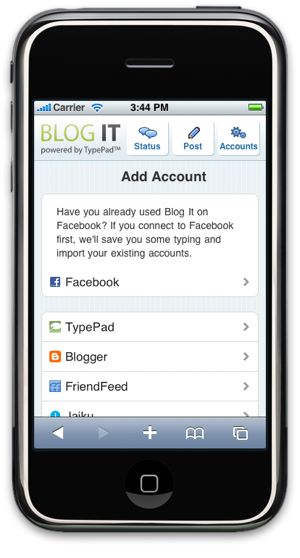 Six Apart, creators of Movable Type, today introduced a free web application, Blog It for iPhone Powered by TypePad.
Built specifically for iPhone’s Safari browser, Blog It for iPhone is designed to let you post blog entries or status updates, from wherever you are, to more than a dozen different online services.
Blog It for iPhone is essentially the mobile version of Six Apart’s Blog It for Facebook application, which was launched in April. Blog It now supports creating content on Blogger, Facebook, FriendFeed, Jaiku, LiveJournal, Movable Type, Pownce, Tumblr, Twitter, TypePad Vox, WordPress.com, and any WordPress.org site.
To try out Blog It for iPhone, visit blogit.typepad.com from your iPhone or iPod Touch. An OpenID, AOL, LiveJournal, Vox, WordPress.com or Yahoo account is required.
Six Apart also plans to have a native TypePad iPhone app available when the App Store launches. TypePad for iPhone lets you post photos from your iPhone to blogs and photo albums on TypePad.
Michael Sippey, Six Apart’s VP of Products, demonstrated this new app during the keynote at Apple’s Worldwide Developers Conference this week in San Francisco.
Expect a flood of similar applications in the next few months that will make it easier to blog and even podcast from the iPhone.
Apple has done a good job of making the iPhone a mobile content client. Now third parties are working to make the iPhone a content publishing platform, too.
Exclusive Interview With Revision3 CEO Jim Louderback
Jun 12th, 2008 | By Elisabeth Lewin | Category: Featured Story, Internet TV, Making Money with Podcasts, New Media Organizations, Podcast Distribution, Podcasting, Podcasting Networks, Video, Video Podcasts  Internet video startup Revision3, the home of Diggnation, XLR8R TV, Epic Fu and other popular video podcasts, has been making headlines since its founding in 2005.
The most recent headlines, though, have surrounded Revision3’s extended outage over Memorial Day weekend, and the way CEO Jim Louderback’s very publicly pointed the finger at anti-piracy firm MediaDefender as the cause for the outage.
Podcasting News’ Publisher Elisabeth McLaury Lewin caught up with Louderback, who answered questions about Revision3, how they plan to respond to the MediaDefender attack and his vision for the future of Internet media.
Revision3’s Vision For Internet Video
Elisabeth McLaury Lewin: Your company name, Revision3, refers to the idea of a “third wave” of television: standard TV being the first, cable the second, and Internet video the third.
What makes this third wave of television important, and how does it define your company?
Jim Louderback: It’s a brand new way to watch video content, and it will ultimately change the previous two revisions.
Unlike many others in this space, who see putting their video, ultimately, on broadcast or cable, Revision 3 believes in making the best video programming for the Internet. That’s different from doing it for broadcast. It’s a new medium, and new media needs a new company to make it work.
Elisabeth McLaury Lewin: You’ve described Revision3 as “the first media company that gets it”. What’s that mean to you?
Jim Louderback: The first one that “gets” that this is a new medium, and is creating content for that medium, rather than just cow-pathing old content into the new space.
Responding To MediaDefender’s Attack
Elisabeth McLaury Lewin: Revision 3’s service died over Memorial Day weekend as the result of a denial of service attack. What was the impact of this attack on your business?
Jim Louderback: We were unable to deliver programming and web pages for 3 days.
Elisabeth McLaury Lewin: On your blog, you pinned the blame for this attack on MediaDefender. Do you think MediaDefender intentionally targeted Revision3 and tried to take you down?
Jim Louderback: No, I don’t think it was intentionally directed at us – but I do believe that they were intentionally targeting anyone distributing bit torrent media who cut their access off.
Elisabeth McLaury Lewin: You use P2P [peer-to-peer] file sharing as a distribution tool. How important is this to your company? Does this help level the playing field for Revision 3?
Jim Louderback: It’s how we got our start, but it’s really not all that important to us. P2P accounts for under 5% of our views.
Elisabeth McLaury Lewin: Do you think MediaDefender is “targeting piracy,” as they claim, or targeting P2P as a distribution platform?
Jim Louderback: I think they are targeting piracy, but were unable to fathom that a legitimate media company would use P2P for distribution.
Elisabeth McLaury Lewin: What’s your response to MediaDefender? Can you comment on whether you’ll take any legal action against them?
Jim Louderback: I probably won’t take legal action, but I am going to send them an invoice.
Read more »
Broadcast Live From Your iPhone With Flixwagon
Jun 12th, 2008 | By James Lewin | Category: Digital Video Recorder, iPhone, Mobile Podcasting, Streaming Video, Video, Video Podcasts, Vlogs  Live webcasting startup Flixwagon announced today that it was testing live “high-quality” video streaming from unlocked iPhones to the web, using Flixwagon’s alpha client.
Here’s Flixwagon’s announcement:
While we don’t condone or recommend unlocking iPhones, as avid iPhone users ourselves we wanted to experiment with ways to enable flixwagon on the iPhone, until the official SDK supports video. We’re going to continue working with the iPhone SDK in the future so we can offer this functionality to all users once video becomes a standard part of the iPhone.
After Flixwagon is installed on the phone, users can broadcast videos with one click to the flixwagon website. Videos can be watched live or saved for later. Also, videos can be embedded in blogs via our flixee widget or uploaded to the user’s YouTube account. Users can also easily determine which of their contacts to share each video with.
We’ll release the iPhone version to our Alpha testers in July.
Here’s a demo of the Flixwagon iPhone app in action:
It’s a bit of stretch to call this high quality video, but it’s a fun application, with obvious uses for vlogging and video podcasting.
This is also exactly the type of thing we were hoping for last year, when we published our list of Five Things Apple Needs To Do To Fix The iPhone:
Fix Publishing From The iPhone – many people that buy a $500-600 phone want to not just consume media with the phone, but to create and publish media with it. While Apple’s managed to make listening to tunes, watching videos and surfing the Web easy and useful on the iPhone, it hasn’t made the iPhone a publishing platform. This seems like an opportunity squandered by Apple; they’re already leaders in the area of podcast and video podcast publishing, they’ve got a deal in place with YouTube, and they’ve got their own blog and podcast publishing technologies. Other vendors are turning their phones into mobile video blogging platforms and are passing Apple by.
Flixwagon’s announcement is of a demo of a beta application on a hacked iPhone.
Let’s hope that they get Apple’s support to turn this into a real iPhone app that you can get through the App Store.
via cnet
Google Isn’t Just Making Us Stupid; It’s Making Us Fat!
Jun 12th, 2008 | By James Lewin | Category: General  Nicholas Carr, in the Atlantic this month, makes the case that Google, and the Internet in general, is making us stupid:
“Over the past few years I’ve had an uncomfortable sense that someone, or something, has been tinkering with my brain, remapping the neural circuitry, reprogramming the memory.
My mind isn’t going—so far as I can tell—but it’s changing. I’m not thinking the way I used to think.
I think I know what’s going on. For more than a decade now, I’ve been spending a lot of time online, searching and surfing and sometimes adding to the great databases of the Internet. The Web has been a godsend to me as a writer. Research that once required days in the stacks or periodical rooms of libraries can now be done in minutes. A few Google searches, some quick clicks on hyperlinks, and I’ve got the telltale fact or pithy quote I was after.
As the media theorist Marshall McLuhan pointed out in the 1960s, media are not just passive channels of information. They supply the stuff of thought, but they also shape the process of thought. And what the Net seems to be doing is chipping away my capacity for concentration and contemplation.
My mind now expects to take in information the way the Net distributes it: in a swiftly moving stream of particles. Once I was a scuba diver in the sea of words. Now I zip along the surface like a guy on a Jet Ski.”
While Carr makes an interesting case, his argument can be turned around. 10 years ago, he spent days floundering around to find what he wanted. Now he finds it in minutes, processing information much more efficiently and productively.
If Google Isn’t Making Us Stupid, Is It Making Us Fat?
While Carr’s article is interesting, I’m much more convinced by the idea that Google, and the Internet in general, is making us fat.
According to recent research by Solutions Research Group, Americans in Web-enabled homes have increased their hours spent watching video by 30% in the last ten years.
- Today, these people view an average of 6.1 hours daily of media content, spanning TV, video-on-demand, videogames, PCs, DVDs and mobile video;
- In 1996, that number was 4.6 hours.
People’s Web and mobile video time will jump from its current one hour per day to about 2.9 hours by 2013. That will be expected to be driven by expanding use of laptops and other mobile devices, such as iPhones.
With clear trends like these, it’s clear that the Internet making us stupid is much less of a concern than the fact that the Internet, and computer-based media in general, is making us fat.
Image: Kim & Amy
Hulu Getting Big Shows, But Not Big Audiences
Jun 12th, 2008 | By James Lewin | Category: Internet TV, Streaming Video, Video  Internet research firm HitWise reports that, while Hulu is getting big shows, it’s not getting big audiences.
Hulu.com., the joint venture between Fox and NBC that provides streaming video content online, came out of beta on March 15 and has seen a steady share of US Internet traffic since:

Alexa’s reach chart mirrors this:

The site ranked 33 among Multimedia websites last week and 84 among television websites.
While it is often compared with YouTube, YouTube is attracting nearly 300 times more traffic than Hulu.com.
Hulu’s developing a library of great long-tail content, but it’s limited by the fact that this content is only available through their Web interface on a computer. To get really big, Hulu will need to cut deals to deliver its content to Internet set-top boxes like Apple TV and work to make viewing Internet television as easy as viewing traditional television.
Apple WWDC Update
Jun 11th, 2008 | By James Lewin | Category: General, iPhone, iPods & Portable Media PlayersWhile the Steve Jobs keynote at the WWDC was underwhelming to many, there’s been a lot of interesting related news that’s come out in the last two days:
- Most iPhone apps are going to be free – Piper Jaffray analyst Gene Munster, took some time Monday following Steve Jobs’s opening keynote to chat with 20 Apple developers. He found that 50% of them were in attendance because they plan to focus solely on developing applications for iPhone and iPod touch. “We found the average cost of iPhone apps on the App Store to be $2.29, with 71% being free,” notes Munster. via appleinsider
- The App Store is coming July 11 – in case that wasn’t clear from the keynote, Apple confirmed this Monday.
- Apple’s App Store could be a $1.2 billion business by next year. In a research note to clients early Wednesday, analyst Gene Munster said his $1 billion market prediction represents the better of a three-case scenario that would add anywhere from 1 to 3% in operating income for Apple by the end of the 2009 calendar year. Munster based this assumption off the adoption rates announced at WWDC for the iPhone’s existing services. “Mobile service adoption rates show that iPhone owners are more sophisticated mobile users, likely a result of both the user profile and the device itself,” the analyst told clients. “The bottom line is that we expect similar adoption of the App Store to other advanced services.” via Digital Daily
- The next version of OS X, Snow Leopard, is losing Power PC support. According to info published by LigicielMac, the Snow Leopard Developer Preview requires an Intel Processor, DVD, 512 MB Ram & 9 GB of disk space. I haven’t seen official confirmation on whether or not the final requirements will match the developer requirements.
HBO Buys Into Will Ferrel’s Funny Or Die
Jun 11th, 2008 | By James Lewin | Category: General, Internet TV, VideoVariety reports that HBO is buying into comedian Will Ferrel’s FunnyOfDie.com.
The site, introduced a little over a year ago, is a sort YouTube clone focusing on comedy. Much of the site’s appeal, though, is the offbeat comedy videos
HBO has bought a small equity stake in the comedy site and has commissioned 10 half-hours of programming from Funny or Die as part of the deal.
The agreement envisions the two sides partnering on a variety of future projects, from the live comedy tours that Funny or Die is planning to a possible Funny or Die-branded programming block on one of HBO’s offshoot channels.
“We do know we want it to be in the same family of the comedy that we’re doing on the website — just a wide range of anything from a funny offbeat talkshow to a maybe more-traditional-type sitcom to a show with puppets,” said Ferrell. “We don’t want to limit ourselves in any way, which is what we love about the stuff that we do for Funny or Die. The spitballing on these ideas is going to be the fun part of all this.”
