Latest News
Verizon Drops Loren Feldman Like He’s Hot
Jul 8th, 2008 | By James Lewin | Category: General, Internet TV, Video, Video Podcasts, VlogsVerizon has backed out of a deal with controversial video blogger Loren Feldman after just a week, after civil rights groups and bloggers protested Feldman’s work, which many consider racist.
Feldman is no stranger to controversy, but his “Technigga” character, in particular, strikes many as bigoted. In a video entitled Where Are The Black Tech Bloggers, Feldman creates a faux black tech vlog, largely based on black stereotypes.
“Verizon CEO Lowell C. McAdam needs to demonstrate that Verizon understands they should demonstrate corporate responsibility and will not tolerate racism, or bigotry,” said Najee Ali, of Project Islamic Hope, one of several groups that protested the deal. “The Verizon distribution deal with Feldman sends a horrible message that Verizon seeks to partner with racists like Feldman and that Verizon and CEO McAdam find nothing offensive with ‘TechNigga’.”
While some think the controversy raises free speech issues, black tech blogger Corvida (ReadWriteWeb) isn’t buying it.
“While Feldman does have a right to Freedom of Speech, that doesn’t mean customers of Verizon should support it.”
“As a customer of Verizon, I don’t want to contribute to Feldman’s bank account and I don’t want Verizon to do so either,” adds Corvida. “We have valid reasons for not wanting his filth on the network where it can be spread and promoted. It’s promoting stereotypes that are perpetuated throughout the world on various levels and one that I as a black female do not wish to see supported on any level.”
Ultimately, Feldman’s biggest problem may be that his idea of comedy is more offensive than funny to a lot of people.
Valleywag’s Mary Jane Irwin called Feldman’s work “stupid, and grossly offensive.” Wired’s Adario Strange said the Technigga video was “Tech Blackface” and that Feldman’s concept of comedy was “living in 1938”.
“There are plenty of people who don’t think TechNigga was funny, and for the record, I am one of them,” writes tech blogger Mathew Ingram. “I get the point that Loren was trying to make (or at least I think I do), but to me it just didn’t work.”
YouTube Ready To Give Up Your Personal Browsing Info
Jul 7th, 2008 | By James Lewin | Category: Featured Story, General, Internet TV, Streaming Video, Video  A few days ago, we suggested that YouTube Needs To Grow A Spine, arguing that YouTube needed to “unequivocally state that they will defend your right to privacy, even if that means taking this all the way to the Supreme Court”:
Your library shouldn’t share what books you read. Your video store shouldn’t share what movies you rent. Your phone company shouldn’t spy on you without due process.
And YouTube shouldn’t share your personal viewing information, for any reason, ever.
YouTube & Google had an opportunity to make clear that they would not share your personal video browsing information with Viacom.
Instead, the company says it’s adding a Privacy link to their site, while it says it will provide information on your private viewing history to Viacom.
What happened to “Don’t be evil”? Viacom could could use this information to “pull an RIAA” and sue you and others for downloading copyrighted media.
Read more »
How To Use Other People’s Work In Your Video Podcast And Avoid Getting Sued
Jul 7th, 2008 | By James Lewin | Category: How to Podcast, Podcasting LawThe Center for Social Media has released a Code of Best Practices in Fair Use for Online Video.
If you have a vlog, video podcast or post videos to sites like YouTube, knowing about fair use could help keep you from getting sued.
Here’s a summary of their recommendations:
Read more »
How The US Army Uses New Media To Attract Recruits
Jul 7th, 2008 | By James Lewin | Category: Corporate Podcasts, Internet TV, Streaming Video, VideoInternet media isn’t just being used by people wanting to limit the role of government in the US; it’s also being used the the goverment itself to attract people to serving in the military.
70 percent of the US Army’s new prospects are attracted via online video campaigns, according to digital ad agency MRM. The company produced videos for the online Army Strong campaign, which features a dedicated site and YouTube videos.
This Beet.tv interview features MRM New York’s Creative Director Michael Jacobs, who heads digital campaigns for the Army, Nikon, and Intel:
Using Internet Media To Fight Domestic Surveillance
Jul 7th, 2008 | By James Lewin | Category: General
Four-hour work week author and blogger Tim Ferris talked to Daniel Ellsberg about new FISA (Foreign Information and Surveillance Act) amendments that promise to let big telecommunications off the hook, retroactively, for giving the government access to spy on you without warrant, and to make this type of activity legal.
The Foreign Intelligence Surveillance Act of 1978 is a U.S. federal law prescribing procedures for the physical and electronic surveillance and collection of “foreign intelligence information” between “foreign powers” and “agents of foreign powers”.
If you want to stand up against the FISA changes, it’s easy to do.
The interview is powerful, controversial and example of the power that individuals have through Internet media.
Read more »
NBC Has No Idea How People Want To Follow Olympics, Hopes To React In Real Time To What It Learns
Jul 7th, 2008 | By James Lewin | Category: General, Internet TV, Streaming Video, Video, Video Podcasts, Vlogs  NBC, in a surprisingly candid statement, admits that it doesn’t know how people want to use the Internet, mobile phones, podcasting and other technologies to follow the Olympics. Instead, the company is trying to measure everything it can and try to react in real time to what it learns.
“I have no idea how people are going to use this stuff,” said Alan Wurtzel, the NBC’s research chief.
Instead, NBC is using the Olympics as a “billion-dollar research lab” to learn how people are using different media platforms. NBC hopes its research provides a comprehensive picture of how people are supplementing TV viewership with tools such as video streaming, video on demand and mobile phones.
NBC has scheduled 3,600 hours of Olympics programming on its main network, along with Telemundo, USA, Oxygen, MSNBC, CNBC and Bravo. In addition, the company is planning to make 2,200 hours of streaming video available on NBCOlympics.com.
NBC hopes to get a picture how people are using multiple media to follow the games.
“The whole idea is to get the same person and to touch them across all different sorts of platforms,” adds Wurtzel.
Unfortunately, coverage of the 2008 Olympics looks like it will largely be missing the new media viewpoint that could have made the event a lot more compelling to people around the world. The International Olympic Committee (IOC) has effectively banned athletes from audio and video podcasting, photoblogging and vlogging their personal takes on the event.
Why Do The Best Hotels Have The Worst Internet Service?
Jul 7th, 2008 | By James Lewin | Category: GeneralI’ve travelled a lot in the last few years, and one thing I’ve noticed is that there seems to be an inverse relationship between the quality of hotels that you stay at and their Internet service: the more you pay for your hotel room, the worse the Internet service seems to be.
I’ve had great free WiFi at Best Westerns, but struggled to connect to $10/day Internet service at more expensive hotels.
My theory is that free WiFi systems are relatively simple to set up and support. Pay Internet service, on the other hand, require more complex firewall configurations, payment systems, additional support, etc, and often have problems as a result.
If you’re involved in new media, reliable free WiFi is a must, so you may want to check out Hotel Chatter’s Hotel WiFi Chart:

Read more »
YouTube Needs To Grow A Spine
Jul 5th, 2008 | By James Lewin | Category: General, Internet TV, Podcasting Law, Streaming Video, Video  YouTube has responded to a federal court order requiring the company, as part of Viacom’s billion dollar lawsuit, to give Viacom copies of YouTube’s server log files.
These log files are needed by Viacom to help it determine the extent to which YouTube has been used to distribute copyrighted content without permission.
However, Viacom doesn’t need the IP address or user IDs of the people accessing videos in order to make its case. IP addresses and user IDs could be used by Viacom to pursue lawsuits against individuals sharing or viewing copyrighted videos, just as the RIAA has sued individual file-sharers.
Viacom should be able to make its case using anonymized logs, which have the IP address & user IDs removed.
YouTube Needs To Grow A Spine
Instead making a definitive statement that it will only share anonymized data, though, YouTube has responded to the court order with a spineless response that lets you know that they are either unable to articulate what they think is right and wrong, or they are just willing to sell you out:
“As you may have seen in the news, YouTube received a court order to produce viewing data from our database, including usernames and IP addresses. In order to protect our community’s privacy, we strongly opposed this motion when Viacom and others filed it.
The court felt differently and ordered us to produce the data. Viacom said that they need general viewing information to determine the proportion of views on YouTube of copyright infringing content vs. non-infringing content.
Of course, we have to follow legal process.”
Of course, YouTube needs to follow legal process. But they should also unequivocally state that they will defend your right to privacy, even if that means taking this all the way to the Supreme Court.
Your library shouldn’t share what books you read. Your video store shouldn’t share what movies you rent. Your phone company shouldn’t spy on you without due process.
And YouTube shouldn’t share your personal viewing information, for any reason, ever.
Image: zombizi
Embed A YouTube Video, Get A Cut Of The Revenue
Jul 5th, 2008 | By James Lewin | Category: Internet TV, Making Money with Podcasts, Streaming Video, Video Google is following up on its promise to make generating revenue from YouTube its top priority.
They’ve announced additional partners that let AdSense publishers embed their videos and share in the ad revenue. They’ve also introduced new video ad units, for additional flexibility.
Their program works by letting you generate revenue for clicks or impressions on ads that are displayed in videos embedded on your site.
Read more »
Podcast Pioneer Dave Winer Intros Tech.newsjunk.com
Jul 5th, 2008 | By James Lewin | Category: General 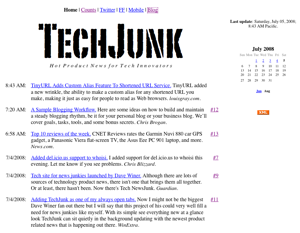 Dave Winer, who created the RSS standard on which podcasting is based, has introduced a new site, Tech.NewsJunk.com, that’s basically a news aggregator presented in river-of-news format.
Winer explains:
“I created the site because I wasn’t getting enough news about products. It’s that simple. I’m interested in the other stuff too, the finance, trends, parties, puppets — but that’s adequately covered on TechMeme. What wasn’t getting through is the stuff I, as a product developer, care the most about — news about products. And the interesting new products I’d find wouldn’t make it onto the bus. If it got bought by Google or Microsoft, that would likely show up on TM, or if a VC invested a lot of money in it. But I like to find out when things are small, before other people invest.”
TechJunk is a TechMeme competitor, but without the intelligent “clumping” and promotion that TechMeme offers.
Some users will like this, because it presents more of an unfiltered stream-of-conciousness view of the news. Whether you find it useful will largely depend on whether you consider TechMeme’s limitation, focusing attention on inane tech gossip, greater than its benefit, autotically bubbling up significant tech topics.
